
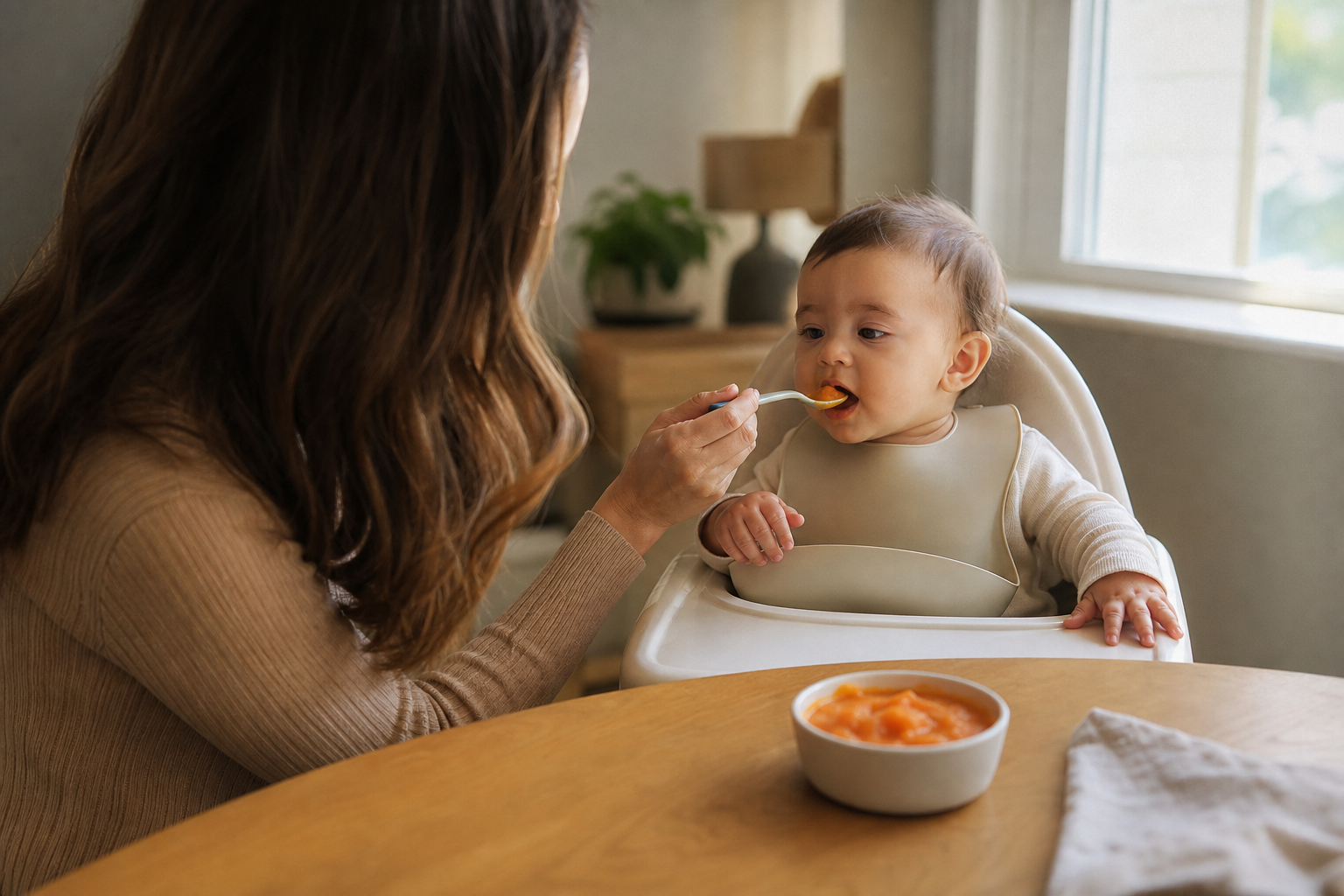
If you're standing in the baby food aisle wondering when can babies start eating organic baby food, here's the short version: the organic label doesn't change the answer at all. Whether the jar says organic or not, the same readiness rules apply, and most babies fall somewhere in the 4 to 6 month window.
What trips parents up is that organic-focused baby food brands and blogs talk about nutrition and pesticides, while general feeding guides talk about developmental milestones, and almost nobody connects the two. This article closes that gap: when solids start, what organic labels actually mean on a baby food jar, how breastfeeding fits into the picture, and exactly which first foods to reach for.
When Can Babies Start Eating Organic Baby Food?
Babies can start eating organic baby food at the same age recommended for any solid food, generally between 4 and 6 months, once specific developmental signs appear rather than on a fixed birthday. The CDC's infant feeding guidance and the American Academy of Pediatrics both frame the start of solids around readiness, not a calendar cutoff.
That means a jar labeled 100% Organic sitting next to a conventional store brand jar carries the exact same age recommendation on the back. Nothing about organic certification accelerates or delays when a baby's gut, motor skills, or swallowing reflexes are ready for food beyond breastmilk or formula.
Is My Baby Ready for Solids?
Your baby is ready for solids when they can sit with support, hold their head steady, and no longer push food back out with their tongue. These three signs matter far more than hitting a specific week or month, and they're the same signs pediatricians check for regardless of what brand of food you plan to serve.
Other cues include leaning forward toward food, opening their mouth when a spoon approaches, and having roughly doubled their birth weight. A baby who still has a strong tongue-thrust reflex, where food gets pushed straight back out, generally isn't ready yet, even if they're already 5 or 6 months old.
If two or more of these signs are missing, it's reasonable to wait another week or two and reassess, organic or otherwise.
Does Choosing Organic Change the Age Recommendation?
No, choosing organic baby food does not change when your baby should start solids. Organic certification governs how food is grown and processed, things like synthetic pesticide use, synthetic fertilizers, and GMO ingredients, but it has no bearing on infant motor development or digestive readiness.
The USDA's organic labeling standards exist entirely separate from pediatric feeding guidance. No major pediatric body, including the AAP, has ever issued a separate age recommendation for organic versus conventional baby food, and there's no biological reason one would exist. A 5-month-old who shows readiness signs can start with an organic sweet potato puree just as safely as with a conventional one.
Pesticide residue testing on commercial baby food, both organic and conventional, has consistently shown levels within established safety tolerances, which is one reason feeding timelines have never been split by organic status in the first place.
What Do Organic Labels Really Mean for Baby Food?
Organic labels on baby food describe ingredient sourcing and farming practices, not nutrition timing, and they come in several distinct tiers that most parents never learn to tell apart. Understanding the tiers helps you compare price against what you're actually paying for.
| Label | What it requires | What it means for your baby's food |
|---|---|---|
| 100% Organic | All ingredients certified organic | No synthetic pesticides or fertilizers anywhere in the product; can carry the full USDA organic seal |
| Organic | At least 95% organic ingredients | Small remainder from an approved non-organic ingredients list; still carries the USDA seal |
| Made with Organic Ingredients | At least 70% organic ingredients | Cannot display the USDA seal; label may only name specific organic ingredients |
| Conventional (no organic claim) | No organic requirement | May use EPA-approved synthetic pesticides within legal residue tolerances |
None of these tiers change the age at which a food is appropriate. A 100% Organic puree and a conventional puree of the same vegetable, texture, and consistency are equally suitable at the same developmental stage.
First Foods for Babies 4 to 6 Months
Good first foods are single-ingredient, iron-rich, and thin enough to run off a spoon. Iron-fortified infant cereal mixed with breastmilk or formula is a common starting point, since a baby's iron stores from birth begin depleting around this age.
Other solid first foods that work well in this stage include pureed sweet potato, avocado, banana, pureed peas, and pureed meats like chicken or beef, which offer additional iron and zinc. There's no required order, the AAP has stated there is no proven nutritional advantage to introducing foods in any particular sequence, so you can start with vegetables, fruit, or fortified cereal based on what your baby seems to like.
Whatever you choose, introduce one new single-ingredient food at a time, waiting 3 to 5 days before adding the next, so you can spot a reaction if one occurs.
Feeding a 4 Month Old: Purees and Readiness Explained
Most 4-month-olds are not yet ready for purees, since 4 months sits at the earliest edge of the readiness window rather than the typical starting point. Some babies hit every readiness sign, head control, sitting with support, no tongue-thrust reflex, by 4 months, but the majority of infants reach that combination closer to 5 or 6 months.
If your baby is exactly 4 months old and asking whether you can start baby food or purees, check the signs from the section above before the calendar. A 5-month-old is somewhat more likely to show full readiness, but individual variation is normal and it's still worth confirming rather than assuming.
If in doubt, a short conversation with your pediatrician at the 4-month checkup will settle it faster than any online checklist.
How Does Breastfeeding Change the Organic Timeline?
Breastfeeding doesn't change when solids, organic or otherwise, should start. It changes one specific nutrient consideration: exclusively breastfed infants need a daily vitamin D supplement, typically 400 IU, starting shortly after birth and continuing regardless of when solids begin, since breastmilk alone is usually low in vitamin D.
Once your baby starts solids around 4 to 6 months, breastmilk or formula still supplies the majority of calories and nutrients until around 12 months. Adding organic purees or cereal to a breastfed baby's diet doesn't reduce the need for the vitamin D supplement, and it doesn't accelerate weaning, since the goal at this stage is exposure to new tastes and textures, not calorie replacement.
The CDC's guidance on vitamin D for infants applies the same way whether the first foods you offer are organic or conventional.
The Three-Stage Feeding Progression: Purees to Finger Foods
Babies move through three broad feeding stages between 4 months and roughly 12 to 18 months, progressing from thin purees to soft finger foods as chewing skills develop. Stage 1, from about 4 to 6 months, is thin, single-ingredient purees, often described as when babies start eating pureed food.
Stage 2, roughly 6 to 9 months, brings thicker purees and larger volumes, typically 2 to 4 tablespoons per feeding, along with simple food combinations. Stage 3, around 10 to 12 months, replaces purees with soft, chewable chunks and finger foods your baby can pick up and self-feed.
By 12 to 18 months, most babies are eating what's often called normal food, meaning softened, appropriately cut versions of family meals rather than jarred purees or stage-specific packaging. This progression is identical regardless of whether the food in the jar or on the plate is labeled organic.
Foods and Ingredients to Avoid Before Age One
Certain foods stay off the table before 12 months regardless of organic status, because the risks involved are about the food itself, not how it was farmed. Honey is never safe before 12 months due to a risk of infant botulism, and whole cow's milk or plant-based milks shouldn't replace breastmilk or formula as a primary drink before the first birthday.
Added sugars have no place in a diet before age 2, and fruit juice should wait until 12 months, after which it's limited to about 4 ounces a day in a cup rather than a bottle. Choking hazards, including whole nuts, grapes, popcorn, and hot dog rounds, need to be avoided or modified (grapes quartered, hot dogs sliced lengthwise) well past the first year.
These rules apply the same way whether you're feeding organic or conventional food, since the danger comes from the food's form or composition, not its farming method.
Frequently asked questions
Can I give my 4 month old baby food?
Only if your baby already shows full readiness signs: steady head control, sitting with support, and no strong tongue-thrust reflex. Most 4-month-olds aren't quite there yet, so many parents wait until 5 or 6 months, but individual development varies.
Should I give my baby organic baby food?
That's a separate decision from timing. Organic food may mean lower pesticide exposure and no synthetic additives, but it doesn't change when solids start or provide proven superior nutrition for infants; either option is safe once your baby is developmentally ready.
When do babies start eating normal food?
Most babies transition to soft, chopped versions of family meals, often called normal or table food, somewhere between 12 and 18 months, after moving through the puree and soft-chunk stages that come before it.
Can I give my 5 month old baby food?
Many 5-month-olds are ready for purees, but confirm the readiness signs first rather than assuming age alone is enough. If your baby can sit with support and no longer pushes food back out with their tongue, starting single-ingredient purees is reasonable.
When can babies start eating organic baby food if breastfed?
The same 4 to 6 month window applies whether a baby is breastfed, formula-fed, or combination-fed. The one addition for exclusively breastfed babies is a daily vitamin D supplement, which continues regardless of when solids begin.