
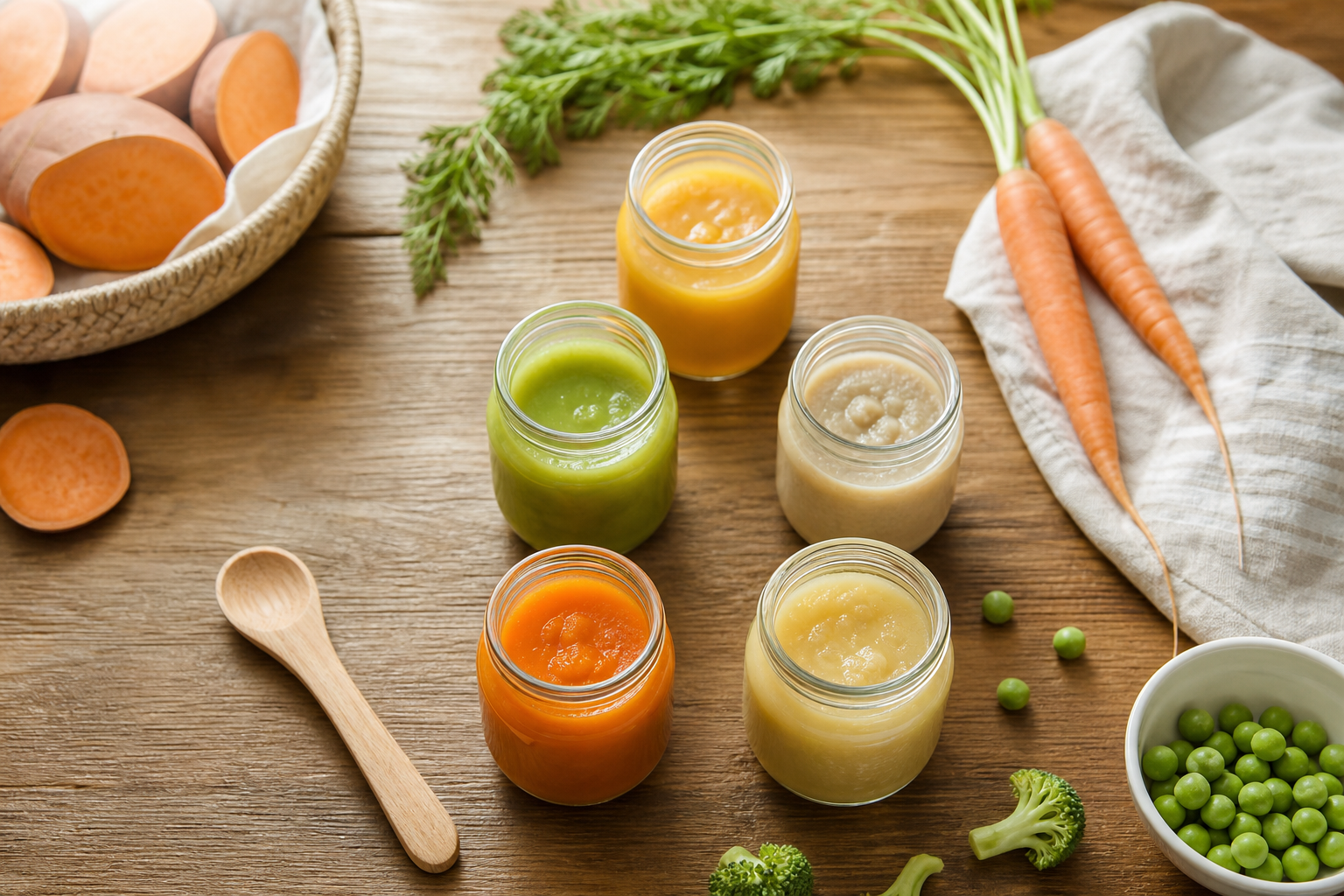
Searching for organic baby food recipes usually means one thing: you want food that's safe, age-appropriate, and doesn't require a food science degree to prepare. The good news is that homemade purees are simpler than most recipe roundups make them sound, but a few safety details, like storage windows and nitrate risk in certain vegetables, get glossed over almost everywhere.
This guide covers exactly that: what "organic" actually changes about your baby's food, how long homemade purees really last in the fridge and freezer, which root vegetables need a second look before 6 months, and full recipe sets for 6-8, 9-12, and 12-18 months, the age band most articles skip entirely.
What Counts as "Organic" Baby Food, and Does It Matter?
"Organic" is a legal certification, not a promise of extra nutrients. USDA-certified organic produce must be grown without synthetic pesticides, synthetic fertilizers, or genetically modified seed, and processed foods need at least 95% organic ingredients to carry the USDA organic seal.
Nutritionally, a widely cited Stanford meta-analysis of over 200 studies found no significant difference in vitamin or mineral content between organic and conventional produce. The real benefit for infants is lower pesticide residue exposure relative to body weight, since a 16-pound baby eating the same pureed apple or sweet potato daily absorbs proportionally more residue than an adult eating a varied diet.
That makes the choice more relevant for some baby-food staples than others. The table below matches common first foods to their residue ranking from the Environmental Working Group's produce lists.
| Food | Residue category | Buy organic worth it? |
|---|---|---|
| Apples | Dirty Dozen | Yes |
| Spinach | Dirty Dozen | Yes |
| Sweet potato | Clean Fifteen | Optional |
| Avocado | Clean Fifteen | Optional |
| Green peas | Clean Fifteen | Optional |
| Carrots | Moderate | Worth it if budget allows |
Practical takeaway: spend the organic premium on apples, spinach, and other Dirty Dozen produce first, and feel comfortable buying conventional avocado, sweet potato, or peas if budget is tight.
How Do I Make My Own Organic Baby Food?
You steam or microwave produce until soft, then puree it with a small amount of breast milk, formula, or water using a blender, food processor, or immersion blender. Steaming beats boiling for nutrient retention because water-soluble vitamins like vitamin C and folate leach into boiling water that then gets poured down the drain; steaming keeps the food out of standing water entirely.
Microwaving with a splash of water and a covered dish performs similarly to steaming and is faster for small batches, roughly 3-5 minutes for a cup of chopped vegetables versus 10-15 minutes steamed.
Basic equipment needed: a steamer basket or microwave-safe covered dish, a blender or immersion blender, a fine mesh strainer for very early Stage 1 purees, and silicone ice cube trays or reusable freezer trays for portioning. Peel and de-seed as needed, cook until fork-tender, blend with liquid until smooth, and thin further with breast milk or formula for the first few weeks of solids.
What Is the 3-Day Rule for Baby Food?
The "3-day rule" actually refers to two separate things that get conflated online, and neither one means homemade puree is good for 3 days in the fridge by default. The first meaning is allergen spacing: after introducing a new single-ingredient food, wait 3-4 days before introducing another new one, watching for rash, vomiting, or unusual fussiness, a practice reflected in CDC guidance on introducing solids.
The second meaning, and the one people usually want when they search this phrase, is storage life. Most homemade purees do not safely last 3 days. Fruit and vegetable purees hold for about 48 hours refrigerated; anything containing meat, poultry, fish, or egg should be used within 24 hours. The table below gives exact numbers by food type.
| Food type | Fridge (40°F / 4°C) | Freezer (0°F / -18°C) |
|---|---|---|
| Fruit or vegetable puree | 24-48 hours | 2-3 months |
| Meat, poultry, or fish puree | 24 hours | 1-2 months |
| Combination meals (meat + veg) | 24 hours | 1-2 months |
| Grain or cereal puree | 48 hours | 1 month |
| Egg-based puree | 24 hours | Not recommended |
These figures align with the safety guidance in the American Academy of Pediatrics' homemade baby food guide. Reheat leftovers to steaming hot (about 165°F/74°C) then cool before serving, and never refreeze puree that's already been thawed.
Are Homemade Root Vegetable Purees Safe? The Nitrate Issue
Homemade purees made from spinach, beets, carrots, and green beans carry a documented nitrate risk for babies under 6 months, and this rarely appears in baby-food recipe roundups. These vegetables naturally absorb nitrates from soil and water, and an infant's immature digestive system can convert nitrate to nitrite, which binds to hemoglobin and reduces the blood's ability to carry oxygen, a condition called methemoglobinemia, described in detail on MedlinePlus.
Younger infants are more vulnerable because they have lower stomach acid and gut bacteria that more readily convert nitrate to nitrite than older babies and adults. Commercial baby food manufacturers test incoming produce lots for nitrate levels before processing; home cooks have no equivalent way to check.
Practical mitigation: for babies under 6 months, buy commercially prepared spinach, beet, carrot, and green bean purees rather than making them from scratch. Once your baby is past 6 months, homemade versions of these vegetables are fine in moderate, occasional amounts, just avoid making them a daily staple, and use filtered or municipally tested water rather than well water when preparing any baby food, since well water can independently raise nitrate levels.
Organic Baby Food Recipes: 6-8 Months
Stage 1 foods should be smooth, thin, and free of lumps, roughly the consistency of yogurt so they drip off a spoon. Offer 1-2 tablespoons per sitting, once or twice daily at first, building to 2-3 times a day by 8 months as breast milk or formula continues to provide most calories.
Avocado mash: mash half a ripe organic avocado with a fork, no cooking needed. Store the pit in the container to slow browning.
Sweet potato puree: steam 1 peeled, cubed organic sweet potato for 12-15 minutes, blend with breast milk, formula, or water until smooth.
Pea puree: steam 1 cup organic peas for 5 minutes, blend, and pass through a fine strainer for the smoothest texture.
Pumpkin puree: steam or roast 2 cups cubed organic pumpkin until soft, then blend with a splash of water.
Organic Baby Food Recipes: 9-12 Months
By 9-12 months, babies need thicker purees with soft lumps and small finger-food pieces to build chewing skills, spread across three meals plus one or two snacks. A typical meal is now 1/4 to 1/2 cup of solids, and iron-rich foods matter more here since iron stores from birth begin declining around 6 months.
Lentil, carrot, and cumin mash: simmer 1/2 cup organic red lentils with 1 chopped carrot in water until soft, about 15 minutes, mash with a fork leaving texture, add a small pinch of cumin.
Scrambled egg with avocado: scramble one organic egg fully, chop into small pieces, serve alongside mashed avocado.
Mini oat-turkey meatballs: mix 1/2 pound ground organic turkey with 1/4 cup rolled oats and one egg, form into pea-sized balls, bake at 375°F for 15 minutes until cooked through.
Soft pasta with veggie sauce: cook small whole wheat pasta shapes until very soft, toss with a smooth tomato-carrot sauce.
Yogurt with mashed blueberries: mash organic blueberries into plain whole-milk organic yogurt.
Organic Baby Food Recipes: 12-18 Months
Between 12 and 18 months, most babies can handle chopped, textured versions of family meals along with a wider range of mild herbs and spices. Salt and added sugar should still be minimal, and honey is now safe to introduce since the infant botulism risk that applies before 12 months has passed.
Roasted veggie sticks: cut organic sweet potato and zucchini into soft, finger-length strips, roast at 400°F for 20 minutes until tender, serve with a mild yogurt dip.
Shredded chicken with rice and peas: shred cooked organic chicken thigh, mix with soft cooked rice and mashed peas.
Spinach and cheese mini muffins: combine egg, shredded cheese, finely chopped cooked spinach, and a spoon of flour, bake in a mini muffin tin at 350°F for 12 minutes.
Herb and spice guidance is one of the most searched-for details parents can't find clear numbers on, so here's a simple reference.
| Category | Examples | Age |
|---|---|---|
| Mild, generally fine | Cinnamon, basil, dill, mint | 6+ months, small amounts |
| Stronger, introduce later | Garlic, cumin, mild curry powder, oregano | 12+ months |
| Avoid before 12 months | Honey, honey-sweetened products | After first birthday only |
| Always minimize | Added salt, added sugar | All ages |
How Much Should You Make, and How Do You Store It?
One pound of produce, roughly two medium sweet potatoes, typically yields about 1.5 cups of puree once steamed and blended with a quarter cup of liquid. That fills twelve standard 1-ounce ice cube tray compartments.
For a 6-8 month old eating 1-2 tablespoons per sitting, that batch covers roughly 6-12 servings, about a week to ten days if that food is in rotation with two or three others. For a 9-12 month old eating 1/4 to 1/2 cup per meal, the same batch stretches across 4-6 meals.
To freeze: pop cubes out once fully solid, usually after 24 hours, transfer to a labeled freezer bag, press out excess air, and note the date. Use within 2-3 months for best texture and flavor, even though it remains technically safe longer in a freezer held at 0°F (-18°C). Thaw overnight in the refrigerator or under cool running water, never on the counter at room temperature.
Homemade vs. Store-Bought Organic Baby Food: Which Is Better?
Neither option wins outright: homemade purees usually cost less and offer more control over texture and ingredients, while store-bought organic pouches save time and come with manufacturer nitrate and contaminant testing that home kitchens can't replicate.
| Factor | Homemade | Store-bought organic pouch |
|---|---|---|
| Cost per 4 oz serving | Roughly $0.40-$0.90 | Roughly $1.50-$2.50 |
| Prep time | About 90 minutes for a 2-week supply | None |
| Fridge life | 24-48 hours | 24-48 hours after opening |
| Unopened shelf life | N/A | 12-24 months |
| Nitrate testing | Not possible at home | Manufacturer-tested |
A practical middle ground many parents use: make staples like sweet potato, avocado, banana, peas, and pumpkin at home where cost savings are largest, and buy commercially prepared spinach, beet, carrot, and green bean purees for babies under 6 months, plus store-bought pouches for travel days when prep time isn't available.
Frequently asked questions
What is the healthiest organic baby food?
No single food earns that title; the most nutritionally valuable combinations pair an iron source, like lentils, meat, or fortified cereal, with a vitamin C food like sweet potato or peas, since vitamin C boosts iron absorption. Variety across the week matters more than any one ingredient.
What is the best homemade baby food?
The best homemade baby food matches your baby's current age and texture ability, rotates iron-rich foods with fruits and vegetables, and skips added salt, added sugar, and honey before 12 months. Consistency with age-appropriate texture matters more than any specific recipe.
What is the 3 day rule for baby food?
It's often used loosely to mean two different things: waiting 3-4 days between introducing new foods to watch for allergic reactions, and a general (often inaccurate) claim about fridge storage. Actual storage life for homemade purees is 24-48 hours, not a flat 3 days.
How do I make my own organic baby food?
Steam or microwave organic produce until fork-tender, then blend with breast milk, formula, or water to the right consistency for your baby's stage. Portion into ice cube trays for the freezer, and thin purees for 6-8 months, keep gentle lumps by 9-12 months, and offer chopped textures by 12-18 months.
Is organic baby food nutritionally better than conventional baby food?
Research shows no significant vitamin or mineral difference between organic and conventional produce; the main benefit of organic is lower pesticide residue, which matters more for infants relative to their body weight. It's a reasonable precaution rather than a nutritional upgrade.
Can I use tap water to make homemade baby food?
Filtered or municipally tested tap water is generally fine, but well water should be tested for nitrate before use in baby food, especially when preparing root or leafy vegetables. This matters most for infants under 6 months.