
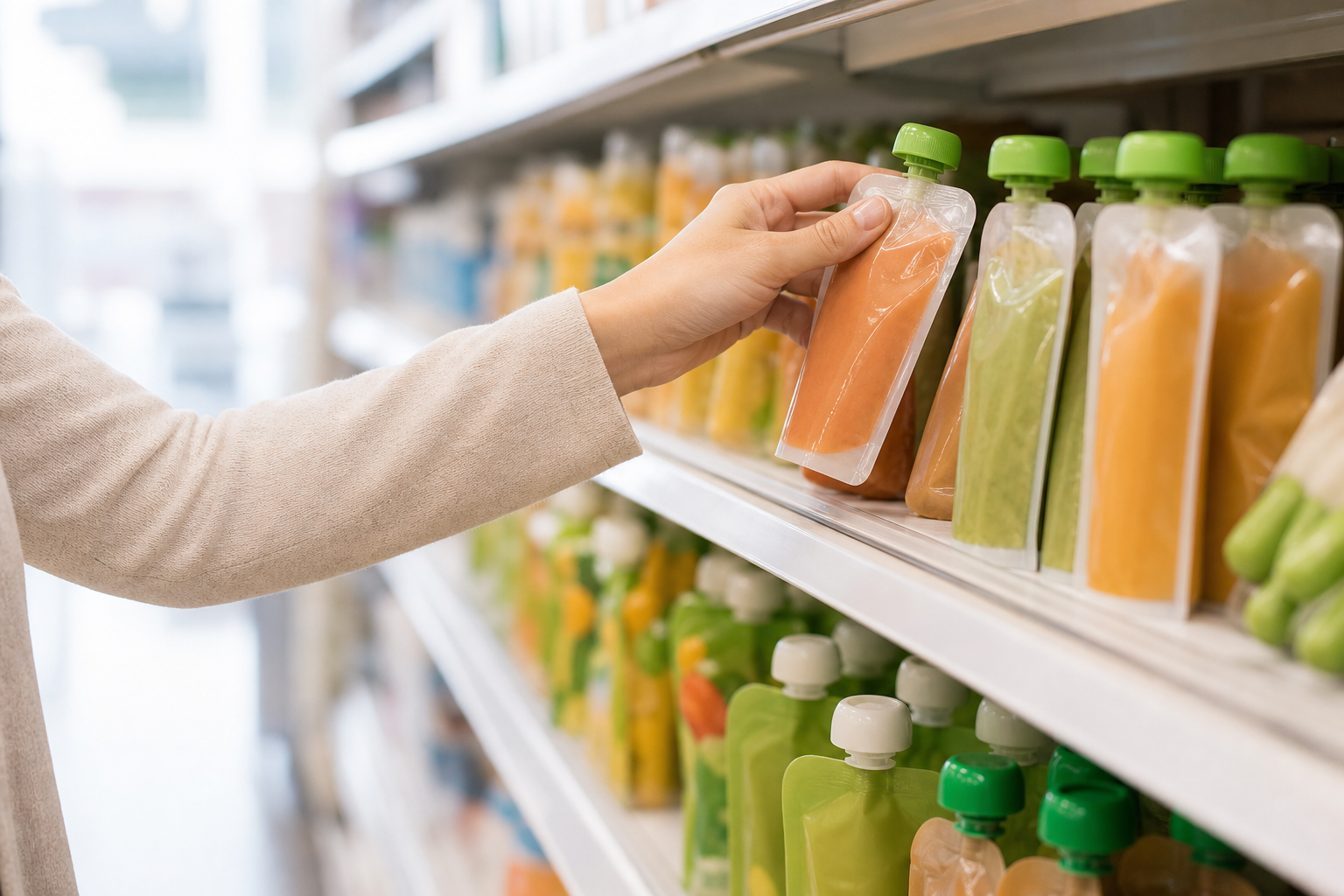
Typing "organic baby food near me" into Google mostly pulls up a map, not answers. But before you tap a pin and buy whatever pouch is closest, it helps to know what you're actually looking at: which claims are legally regulated, which are just packaging language, and which products have been independently tested for contaminants rather than just self-described as clean.
This guide skips the brand-by-brand marketing tour you'll find on most retailer pages and focuses on the two things a parent standing in a store aisle, or scrolling a delivery app, actually needs: how to vet what's in front of you, and how to find it wherever you live, whether that's a grocery chain in Austin or a farmers market in Sacramento.
What Does "USDA Organic" Actually Mean for Baby Food?
USDA Organic certification means at least 95% of a product's ingredients were grown without synthetic pesticides, synthetic fertilizers, sewage sludge, irradiation, or genetic engineering, and that the processing facility follows federal record-keeping and inspection rules under the National Organic Program.
That's a legal standard enforced by USDA-accredited certifying agents, with penalties for misuse of the seal. "Clean label," "ethically sourced," and "non-GMO" are not the same thing. None of those three phrases has a federal legal definition, which is why a brand can print "clean label award" on a pouch that is not certified organic at all.
Practical check: if a product only says "non-GMO" or "clean label" but shows no green-and-white USDA Organic seal, it has not met the pesticide and additive restrictions that certification requires. Look for the seal itself, not the adjacent marketing copy.
Finding Organic Baby Food Near Me: California, Texas, and Every State
A single city's directory listing goes stale fast and doesn't help a parent in Dallas or Sacramento. A repeatable method works everywhere instead of relying on one local list.
Start with the USDA Organic Integrity Database, a searchable federal registry of every certified organic operation in the country, including baby food processors. You can confirm a brand's certification status directly rather than trusting a label.
Then use store locators on brand sites (Gerber, Earth's Best, Once Upon a Farm, and Happy Family Organics all have one) to find the nearest stocking retailer. In Texas, H-E-B, Central Market, Sprouts Farmers Market, and Whole Foods carry the widest organic baby food selection; in California, Erewhon, Bristol Farms, Sprouts, and Whole Foods do the same, with many regions also having weekly farmers markets that sell small-batch organic purees.
If nothing is nearby, refrigerated and shelf-stable delivery subscriptions (Once Upon a Farm, Babyblends, Cerebelly) ship to most U.S. zip codes, which matters most for rural areas without a specialty grocer.
What Is the 3-Day Rule for Baby Food?
The 3-day rule refers to homemade baby food, not store-bought pouches: most fruit and vegetable purees stay safe refrigerated for up to 3 days, while homemade meat, fish, or egg purees should be used within 24 hours, according to HealthyChildren.org, the American Academy of Pediatrics' parent site. Frozen homemade purees keep for about 3 months in ice-cube trays or freezer containers.
Opened store-bought pouches follow a different, shorter timeline. Manufacturers generally recommend refrigerating an opened pouch and using it within 24 to 48 hours, and some shelf-stable pouches are only rated safe unrefrigerated for a few hours once opened (Once Upon a Farm specifies 4 hours at room temperature). Check the individual package, since this detail varies by brand and is easy to miss on a busy morning.
Example: if you open a 4-ounce organic pouch at breakfast and your baby only eats half, refrigerate the rest immediately and use it by the next day, don't leave it in the diaper bag until lunch.
What Is the Safest Organic Baby Food?
No single brand can honestly claim to be the "safest," because organic certification does not test for or guarantee low heavy metal levels. Arsenic, lead, and cadmium occur naturally in soil and water, so organic crops can absorb them just like conventional ones.
The most cited independent data comes from Healthy Babies Bright Futures, a public health coalition whose "What's in My Baby's Food" testing report found at least one heavy metal in 95% of 168 baby foods tested, regardless of organic status. In response, the FDA's Closer to Zero action plan finalized lead limits in January 2025: a cap of 10 parts per billion for most fruit, vegetable, meat, and grain-based baby foods, and 20 parts per billion for single-ingredient root vegetables like carrots and sweet potatoes, which naturally accumulate more lead from soil.
What a parent can actually check: whether a brand publishes third-party test results (not just its own claims), whether it participates in independent testing programs like Clean Label Project, and whether a specific lot has an open FDA recall by searching the FDA's recall database. Rotating fruits, vegetables, and grains rather than feeding the same puree daily also reduces cumulative exposure to any single contaminant, a point pediatric nutrition guidance emphasizes more than any single product choice does.
What Is the Healthiest Food for a Baby?
The healthiest food for a baby is an iron-rich, allergen-diverse diet introduced around 6 months, not a single "superfood" pouch. The World Health Organization's complementary feeding guidance recommends starting solids at 6 months alongside continued breastfeeding or formula, with iron-fortified cereals or pureed meats among the first foods, since babies' iron stores from birth begin depleting around this age.
The CDC's infant nutrition guidance lists pureed meats, iron-fortified cereals, beans, and lentils as priority first foods for this reason, alongside introducing common allergens like peanut and egg early and repeatedly to reduce allergy risk, per current pediatric allergy guidance.
A pouch labeled with "16 brain-supporting nutrients" or "5 grams of protein" is describing that specific product's formulation, not a pediatric feeding standard. Those numbers can be true and still not add up to a complete complementary feeding plan if a baby only eats fruit-forward pouches and skips iron sources.
Store, Subscription, or Homemade: Which Actually Costs Less?
Homemade organic puree is consistently the cheapest per ounce, but it costs the most time; refrigerated delivery subscriptions are the most expensive per ounce but require none.
Here's roughly how the three main options compare for a single feeding, based on typical U.S. retail and subscription pricing:
| Feeding method | Typical cost per ounce | Shelf life | Ingredient control |
|---|---|---|---|
| Homemade organic puree | $0.10 to $0.20 | 24 to 72 hrs fridge, ~3 months frozen | Full |
| Shelf-stable store pouch | $0.30 to $0.45 | 12 to 18 months unopened; 24 to 48 hrs opened | Moderate |
| Refrigerated delivery subscription | $0.45 to $0.65 | 4 hrs unrefrigerated; days refrigerated per label | Moderate to high |
Example: a 4-ounce shelf-stable pouch priced at $1.49 runs about $0.37 per ounce, while a home-blended batch of organic sweet potato and pear made from $4 of bulk produce yielding 32 ounces costs roughly $0.13 per ounce. Subscriptions often discount the first order (some brands offer 30 to 40% off), which narrows the gap temporarily but rarely erases it long term.
What Business Does Jennifer Garner Own?
Jennifer Garner co-founded Once Upon a Farm, an organic baby food and kids' snack company, in 2015 alongside entrepreneurs John Foraker and Cassandra Curtis, and now serves as its Chief Brand Officer, according to the company's own about page.
The brand is known for cold-pressure processing (high-pressure processing, or HPP) instead of heat pasteurization to preserve nutrients, and for refrigerated pouches sold in the fridge, freezer, and baby aisle sections of many grocery stores.
Her celebrity involvement has helped the brand's visibility and retail placement, but it doesn't substitute for checking certification, heavy metal testing, and ingredient lists the same way you would for any other organic baby food, celebrity-founded or not.
How Do You Choose the Best Organic Baby Food Near Me?
The best organic baby food near you is whichever option passes four checks: certified organic status, published safety testing, an age-appropriate ingredient match, and a price you can sustain weekly.
Use this checklist at the shelf or before checkout:
- USDA Organic seal visible on the package, confirmed against the USDA Organic Integrity Database if you're unsure
- Ingredient list under 8 to 10 items with recognizable whole foods, not just fruit purees stacked for sweetness
- Age-stage match (6+, 8+, 12+ months) tied to texture and choking-hazard size, not just marketing copy
- Iron or protein source included at least once daily, not only fruit and vegetable pouches
- Price per ounce calculated, not just price per pouch, so you can compare fairly across brands and formats
- Any public heavy metal testing data or recall history checked before repeat-buying the same product weekly
A healthy organic baby food near you is rarely the single "best" pouch on a shelf; it's usually a rotation of two or three brands and formats that together cover iron, variety, and your actual budget.
Frequently asked questions
What is the safest organic baby food?
No brand can be honestly labeled the single safest, since organic status doesn't test for heavy metals. The safest approach is choosing brands that publish independent heavy metal testing data, checking FDA recall records, and rotating ingredients rather than relying on one product daily.
Where can I find organic baby food near me in Texas or California?
In Texas, check H-E-B, Central Market, Sprouts Farmers Market, and Whole Foods. In California, Erewhon, Sprouts, Bristol Farms, and Whole Foods carry the widest organic baby food selection, and both states have farmers markets selling small-batch purees. Confirm certification through the USDA Organic Integrity Database rather than relying on store labels alone.
What is the 3-day rule for baby food?
It's a food safety guideline for homemade purees: fruit and vegetable purees stay safe refrigerated for up to 3 days, while homemade meat, fish, or egg purees should be used within 24 hours. Store-bought opened pouches follow shorter windows, typically 24 to 48 hours refrigerated, per the package instructions.
What business does Jennifer Garner own?
Jennifer Garner co-founded Once Upon a Farm, an organic baby food and snack brand, in 2015 and now serves as its Chief Brand Officer. The company is known for cold-pressure processed, refrigerated organic pouches sold in grocery stores nationwide.
What is the healthiest food for a baby?
Pediatric guidance points to iron-rich foods, like pureed meats, beans, or iron-fortified cereal, introduced around 6 months alongside a variety of fruits and vegetables and early allergen exposure. No single branded pouch replaces this broader nutritional pattern.
How do I find the best organic baby food near me on a budget?
Compare price per ounce rather than price per pouch, since shelf-stable pouches and homemade purees can cost less than $0.20 to $0.45 per ounce compared to $0.45 to $0.65 for refrigerated subscriptions. Batch-cooking organic produce at home is the cheapest option if you have the time to prep it weekly.
Sources
- USDA National Organic Program Rules and Regulations (2024)
- FDA Closer to Zero: Action Plan for Baby Foods (2025)
- Healthy Babies Bright Futures: What's in My Baby's Food (2019)
- HealthyChildren.org: Make Your Own Baby Food (2023)
- CDC Infant and Toddler Nutrition: Iron (2023)
- WHO Complementary Feeding Guidance (2023)
- Once Upon a Farm About Us (2024)
- Clean Label Project (2024)