
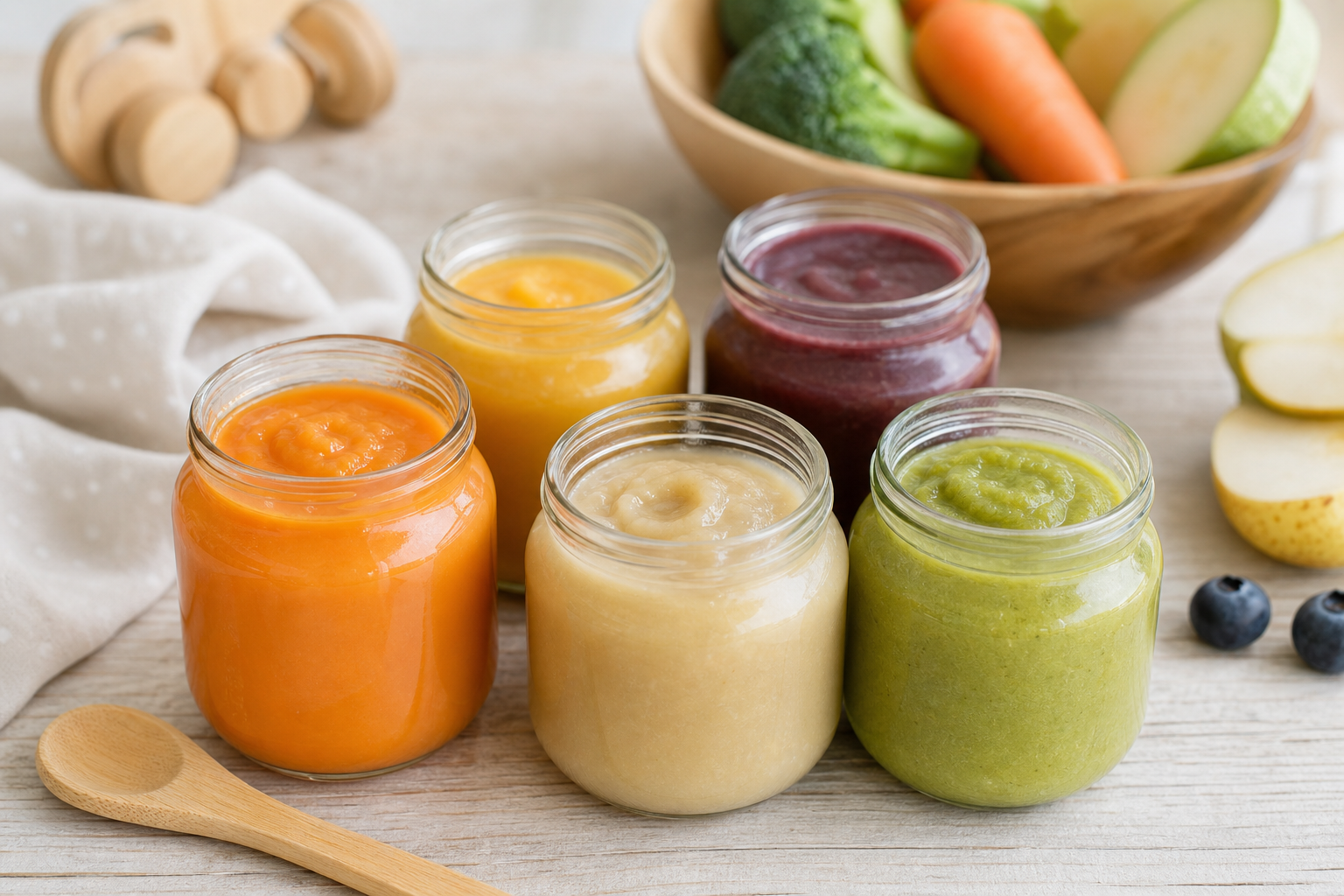
Choosing the best organic baby food feels like it should be simple: buy the jar with the USDA seal and move on. But a 2021 congressional investigation and years of independent lab testing have shown that organic certification and low heavy metal content are two completely separate promises, and a product can deliver one without the other.
This guide separates those two claims, gives you the actual FDA thresholds brands are tested against, and names which organic baby food brands publish results, which were flagged by regulators, and what to feed a 6-month-old to meet real nutrient targets rather than marketing ones.
Organic Certification Explains Pesticides, Not Heavy Metals
USDA Organic certification means a food was grown without synthetic pesticides, synthetic fertilizers, sewage sludge, or genetic engineering, and that processed products contain at least 95% organic ingredients. That is the entire scope of the label. It says nothing about arsenic, lead, cadmium, or mercury.
Heavy metals get into baby food through a different route entirely: they occur naturally in soil, groundwater, and air, and certain crops draw them up more efficiently than others regardless of how they were farmed. A carrot grown on an organic farm in soil with legacy lead contamination (from old paint, leaded gasoline residue, or industrial runoff) can test higher for lead than a conventionally grown carrot from cleaner soil. Farming method does not change a plant's ability to absorb what is already in the ground.
This is why every credible source, including the FDA's Closer to Zero initiative, treats organic status and contaminant testing as two unrelated questions. A parent shopping for the best organic baby food needs to check both boxes separately, not assume one implies the other.
What Are the FDA's Heavy Metal Action Levels, and Which Brands Meet Them?
The FDA has set specific numeric limits for two of the four heavy metals of concern, and no organic baby food brand is exempt from them. For inorganic arsenic in infant rice cereal, the action level is 100 parts per billion (0.1 ppm), finalized in 2020. For lead, the FDA's January 2025 guidance sets 10 ppb for most processed baby foods, purees, yogurts, and single-ingredient meats, and 20 ppb for single-ingredient root vegetables and dry infant cereal. Action levels for cadmium and mercury are still in development.
Not every brand publishes results against these numbers, and that gap matters more than any ingredient list. The table below reflects publicly available information on organic status, whether a brand shares heavy metal test data, and whether it was named in the 2021 congressional findings discussed later in this article.
| Brand | USDA Organic | Publishes Heavy Metal Test Data | Named in 2021 Report | Rice-Based Products | Best Use Case |
|---|---|---|---|---|---|
| Serenity Kids | Most products | Yes, batch summaries online | No | Minimal | Stage 1, high protein/fat blends |
| Once Upon a Farm | Yes | Yes, third-party tested | No | No | Cold-pressed purees, Stage 1-2 |
| Cerebelly | Partial line | Yes, published on site | No | Some blends | Nutrient-dense multi-ingredient purees |
| Happy Baby Organics | Yes | Limited public disclosure | Yes | Some oat/rice blends | Budget-friendly organic staples |
| Earth's Best | Yes | Limited public disclosure | Yes | Yes | Wide product variety |
| Gerber Organic | Yes | Select lines only | Yes | Yes | Availability, low cost |
| Beech-Nut | Some lines | Improved since 2021 | Yes | Reduced since 2021 | Stage 2-3 textures |
Serenity Kids and Once Upon a Farm currently combine both organic sourcing and public test transparency most consistently, which is why they anchor most recommendations below.
The Best Organic Baby Food Brand Overall: Serenity Kids and Once Upon a Farm
For most families, Serenity Kids is the strongest all-around choice because its purees are organic, high in protein and fat (which most infant purees lack), and backed by publicly shared batch testing that stays under FDA action levels. Its meat and vegetable blends avoid rice fillers entirely.
Once Upon a Farm is the closest runner-up. Its cold-pressed process preserves more nutrients than heat-processed purees, and the company has built its brand identity around third-party lab verification rather than just an organic label.
Neither company claims to be heavy-metal-free, and that honesty is itself a signal worth trusting, for reasons explained next.
Best Organic Baby Food Without Heavy Metals: Is That Even Possible?
No, and any brand claiming true zero heavy metal content should raise suspicion rather than reassurance. Arsenic, lead, and cadmium exist in trace amounts in virtually all soil and water, which means they show up at low levels in almost all fruits, vegetables, and grains, organic or not.
What you can realistically buy is baby food that tests below the FDA's action levels and publishes proof of it. That is a meaningfully different, and achievable, standard. When a brand's marketing says "clean" or "pure" without a linked lab report or Certificate of Analysis, treat that as a clean label claim, not a tested claim. The two are not interchangeable, and only one of them is verifiable by a parent reading the website.
Single-Ingredient Purees Have the Cleanest Ingredient Labels
The cleanest baby food ingredient lists belong to single-ingredient purees such as plain organic sweet potato, pear, or pea, because there is nothing to hide behind a blend name. Multi-ingredient pouches can bury added tapioca starch, fruit juice concentrate, or excess added sugar under an appealing product name.
When comparing labels, check for three things: no added sugars or juice concentrates (a 6 to 12 month old needs none), no more than one or two thickening starches, and clear allergen labeling for the top nine allergens if the product contains egg, dairy, peanut, or tree nut ingredients introduced early per current pediatric guidance.
Brands like Serenity Kids and Once Upon a Farm tend to keep ingredient counts low by design, which also makes it easier to identify a reaction if one occurs.
What's the Best Organic Baby Food for Stage 1 (6 Months)?
The best Stage 1 organic baby food is a single-ingredient puree paired with an iron-rich food, because iron, not fruit variety, is the actual nutritional priority at 6 months. The American Academy of Pediatrics and CDC infant nutrition guidance put the requirement at 11 mg of iron per day for babies 7 to 12 months, and breastfed infants in particular start running low on stored iron around 6 months.
Most fruit and vegetable purees, organic or not, contribute close to zero iron. A serving of iron-fortified infant oat cereal typically supplies roughly 4 to 7 mg, meeting close to half the daily target in one sitting, while pureed meat (chicken, turkey, or beef) delivers heme iron, the form the body absorbs most efficiently. A Stage 1 plan built only from fruit and vegetable pouches, however organic, will not meet an infant's iron needs on its own.
Texture at this stage should be a thin, single-ingredient puree with no chunks, introduced one new food at a time over 3 to 5 days to watch for reactions.
Is Rice-Based Baby Food Riskier Than Other Grains?
Yes, rice consistently tests higher for inorganic arsenic than any other grain used in baby food, because rice is grown in flooded paddies that let the plant draw arsenic up from soil and irrigation water far more efficiently than wheat, oats, or barley. This is a well-documented agronomic fact, not a brand-specific issue, which is why the FDA set a dedicated arsenic action level only for infant rice cereal.
In practice, that means rice cereal, rice-based teething biscuits, and rice puff snacks carry the highest cumulative arsenic exposure risk of any baby food category if fed daily. Alternating with oat, barley, quinoa, or multigrain cereal, and limiting rice-based products to 2 to 3 servings a week rather than daily, meaningfully lowers total exposure without eliminating a food group.
Have Any Organic Baby Food Brands Been Recalled or Flagged by Regulators?
Yes. In February 2021, the House Oversight Committee's Subcommittee on Economic and Consumer Policy released a staff report based on internal company testing data from Beech-Nut, Gerber, Earth's Best (Hain), and Happy Baby Organics (then under Nurture Inc.), finding that some products contained arsenic, lead, or cadmium above the companies' own internal safety limits. Walmart, Sprout Organic Foods, and Campbell (Plum Organics) declined to provide their internal data to the committee.
Beech-Nut discontinued its single-grain rice cereal following the report and has since said it expanded internal testing. Hain and Gerber have both stated publicly that the majority of their products already fell under the FDA's proposed action levels, though neither publishes full batch-level results the way Serenity Kids or Once Upon a Farm do.
To check any brand yourself, search the product name and lot number in the FDA recall database before buying, since recall status can change between printings of any roundup article, including this one.
A Weekly Rotation Plan to Reduce Cumulative Heavy Metal Exposure
Dietitians generally recommend rotating grains and proteins across the week rather than relying on one brand or one recipe repeated daily, since exposure risk comes from cumulative intake of any single contaminated source, not from any one meal. A practical example: serve rice cereal on Monday and Thursday only, oat cereal on Tuesday and Friday, and barley or quinoa cereal on Wednesday and Saturday, leaving Sunday flexible.
Do the same with protein purees. Instead of chicken and sweet potato every day, rotate between chicken, turkey, lentil, and salmon purees across the week, and vary vegetable purees between root vegetables (carrot, sweet potato) and non-root vegetables (peas, zucchini, squash) since root vegetables tend to carry higher cadmium levels.
This costs nothing extra if you are already buying a variety of jars, and it applies regardless of which organic baby food brand ends up in the cart.
Frequently asked questions
What is the healthiest brand of baby food?
Based on published test transparency and organic sourcing, Serenity Kids and Once Upon a Farm currently rank highest. Both avoid rice fillers, publish batch or third-party test summaries, and were not named in the 2021 congressional findings on heavy metals.
Is homemade baby food safer than organic store-bought food?
Not automatically. Homemade purees skip processing additives but still use produce grown in the same soil and water as commercial crops, so heavy metal exposure depends on your specific ingredients, not on whether the food came from a jar or your own kitchen.
Best organic baby food without heavy metals: does that actually exist?
No product is entirely free of trace heavy metals since they occur naturally in soil and water. The realistic standard is a brand that tests below FDA action levels and publishes the results, which Serenity Kids and Once Upon a Farm currently do.
How do I check if my baby food brand has been recalled?
Search the product name, brand, and lot number in the FDA's recall and safety alert database, which is updated as new recalls are issued. Do this before each purchase since recall status can change over time.
Should I avoid all rice-based baby food?
You do not need to eliminate rice entirely, but limit rice cereal, rice puffs, and rice-based snacks to 2 to 3 servings a week and alternate with oat, barley, or quinoa on other days to lower cumulative arsenic exposure.
What's the healthiest first food for a 6-month-old?
An iron-rich food, either iron-fortified infant oat cereal or a pureed meat like chicken or turkey, since 6-month-olds need about 11 mg of iron daily and most fruit and vegetable purees contribute very little of that.