
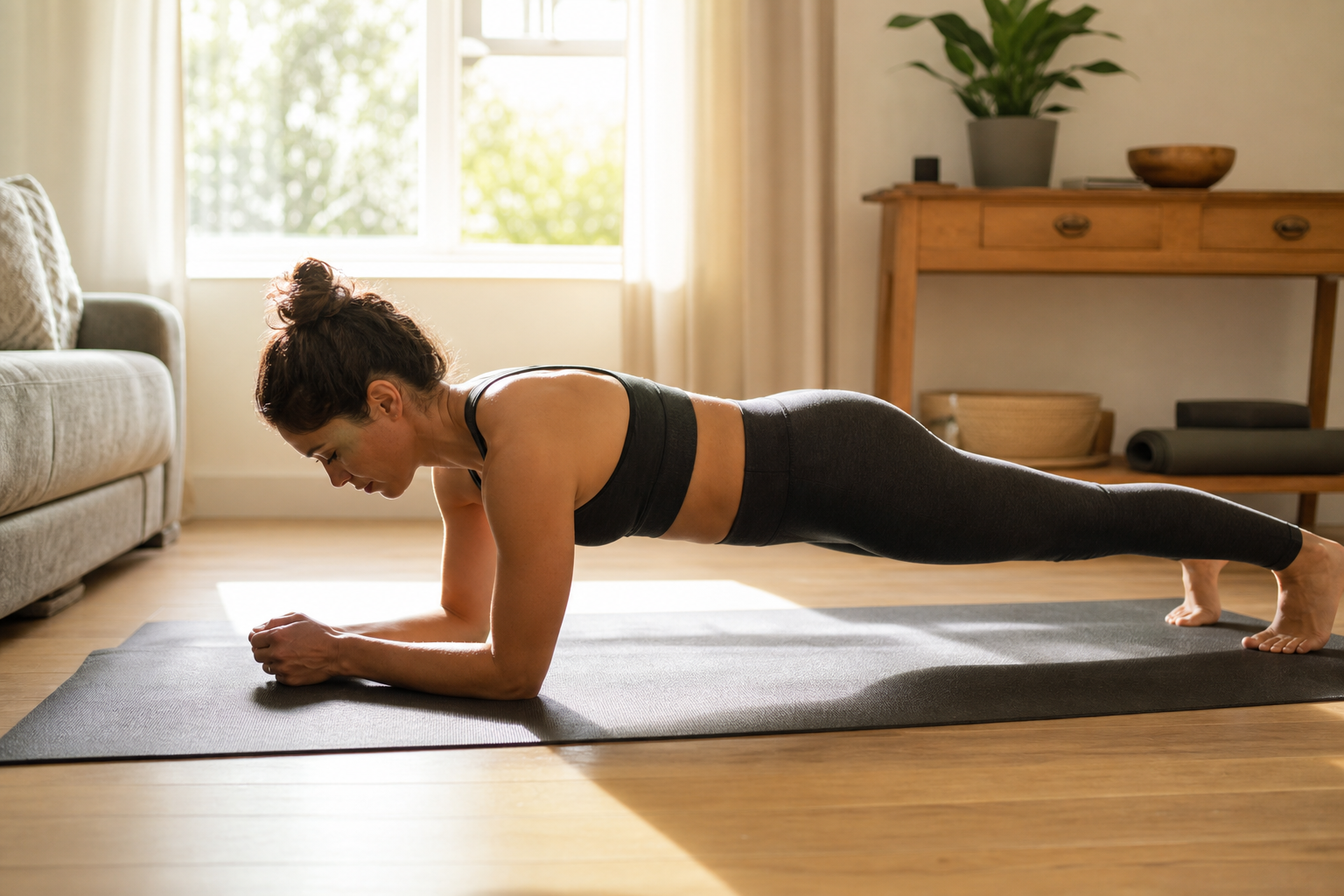
If you scrolled past a fitness reel this week, there's a decent chance you saw the numbers 5-5-5-30 stacked next to a plank timer. So what is the 5-5-5-30 rule, exactly, and does a routine that short do anything at all? The short version: it's a bodyweight micro-circuit built for consistency, not a substitute for a real strength program, and the two goals get confused constantly online.
This article resolves the rep-counting confusion, quantifies how long the routine actually takes, checks the cognitive-benefit claims against the research they're borrowed from, and shows how 5-5-5-30 differs from the 3-3-3 rule, Jennifer Aniston's 15-15-15, and the classic 5x5 workout.
What Is the 5-5-5-30 Rule, Exactly?
The 5-5-5-30 rule is a two-to-three-minute bodyweight circuit: 5 push-ups, 5 bodyweight squats, 5 lunges per leg, and a 30-second plank, usually done first thing in the morning before coffee or a shower. It's less a workout program and more a habit trigger, something small enough that skipping it feels harder than doing it.
The routine is widely attributed to Sahil Bloom, a content creator known for distilling health and productivity ideas into simple frameworks, though it's since been repeated and remixed across fitness social media without a single fixed source.
One detail gets lost in most explainers: the lunge count. Every credible version of the routine counts lunges per leg, meaning 10 total reps (5 left, 5 right), not 5 lunges total. That distinction matters for balance and matches how lunges are programmed in basically every strength context, since doing one leg without the other creates an obvious imbalance.
How Long Does the 5-5-5-30 Routine Actually Take?
One round of 5-5-5-30, done back to back with minimal rest, takes about 90 seconds to 3 minutes depending on pace and how winded you get on the plank. Add 15 to 30 seconds of rest between each move and you're looking at closer to 4 minutes total for a beginner.
There's no official prescription for how many rounds to do. Most people treat it as a single round done once each morning, but some versions circulating online suggest 2 to 3 rounds spaced through the day (morning, midday, evening), which would push total time to 10 to 15 minutes and roughly triple the workload.
In terms of exertion, this is a low-to-moderate intensity circuit. For a 70 kg (154 lb) adult, one round burns somewhere in the range of 8 to 15 calories, similar to a brisk two-minute walk. That's not a criticism, it's just useful context: 5-5-5-30 is a habit cue, not a calorie-burning session.
Is the 5-5-5-30 Rule Actually Effective?
On its own, the 5-5-5-30 rule is too low in volume to build meaningful strength by exercise-science standards, but it works well as a consistency anchor that can lead into more structured training. That's a fair, evidence-based way to frame it, rather than calling it either useless or transformative.
The American College of Sports Medicine's exercise prescription guidance recommends 2 to 4 sets of 8 to 12 reps per major muscle group, on 2 to 3 non-consecutive days per week, to produce measurable strength gains in healthy adults, a benchmark laid out in its widely cited position stand on exercise quantity and quality. Five bodyweight reps of a push-up or squat is submaximal for most people who can already complete the movement, meaning the routine doesn't create the mechanical overload muscles need to adapt.
Where it earns its keep is behavioral, not physiological. Public health guidance from the CDC's physical activity recommendations calls for muscle-strengthening activity involving all major muscle groups on 2 or more days a week, and 5-5-5-30 technically checks that box at the lowest possible effort threshold. It's a floor, not a ceiling: a reasonable way to hit the minimum on a busy day, not a plan that builds visible strength by itself over months.
What Does the Science Really Say About the "Brain Boost" Claims?
The cognitive benefits credited to 5-5-5-30 come from research on general strength and aerobic training, not from any study that tested this specific 2-to-3-minute circuit, so the brain-boost claims are borrowed science, not proven ones. That gap is worth stating plainly, since it rarely gets mentioned where the routine is described.
Claims about brain-derived neurotrophic factor (BDNF), a protein linked to neuron growth and memory, and increased cerebral blood flow are real findings from exercise physiology, but the studies behind them used sustained programs, typically 30 to 60 minute sessions, several times a week, over 8 to 26 weeks. A widely referenced review found meaningful cognitive improvements in adults over 50 from structured aerobic and resistance programs averaging around 45 minutes per session, not from single sub-3-minute bodyweight circuits.
The closest evidence for "short exercise helps the brain" comes from a 2018 study in which participants cycled at very light intensity for just 10 minutes and showed improved activity in the hippocampus, a brain region tied to memory, measured via functional MRI in a PNAS study on brief mild exercise. Ten minutes of continuous cycling is still a different exposure than 15 bodyweight reps and a 30-second hold, so even this supportive finding doesn't map cleanly onto 5-5-5-30. Treat any claim that this specific routine "boosts focus" or "prevents cognitive decline" as plausible in theory, unverified in practice.
5-5-5-30 vs. the 3-3-3 Rule, 15-15-15, and 5x5 Workout
These names circulate in overlapping searches but describe genuinely different systems with different goals, and mixing them up leads to the wrong expectations.
| Routine | Structure | Primary Goal | Best For |
|---|---|---|---|
| 5-5-5-30 | 5 push-ups, 5 squats, 5 lunges/leg, 30-sec plank | Morning habit, minimum strength floor | Beginners, non-gym days |
| 3-3-3 rule | Walk 3 minutes, 3 times a day, for 3 weeks | Gradual postpartum or post-injury return to movement | Postpartum recovery, deconditioned starters |
| 15-15-15 (Jennifer Aniston) | Reportedly 15 min cardio, 15 min strength, 15 min stretch/mobility | Full 45-minute balanced session | People with a dedicated workout block |
| 5x5 workout | 5 sets of 5 reps on compound barbell lifts (squat, bench, deadlift, row, press) | Progressive strength and hypertrophy | Gym-goers wanting measurable strength gains |
The 3-3-3 rule is also used outside fitness (a grounding technique for anxiety), so context matters when someone brings it up. The 15-15-15 attributed to Jennifer Aniston is reported through her trainer's interviews rather than a fixed public protocol, so treat the exact minute splits as approximate. The 5x5 workout, popularized by programs like StrongLifts 5x5, is the only one of these built around progressive overload with added weight, which is why it produces strength results the other three aren't designed to deliver.
10,000 Steps or 30 Minutes of Exercise: Which Wins?
Neither wins outright, because they measure different things: step count tracks total daily movement volume, while 30 minutes tracks structured moderate-to-vigorous activity, and both correlate with health benefits independently.
A large cohort study published in JAMA followed over 4,800 adults and found mortality risk kept dropping up to around 7,500 to 8,000 steps a day, after which the benefit curve flattened, meaning 10,000 steps isn't a hard biological threshold so much as a round, memorable marketing number. Meanwhile, the CDC's 150-minutes-a-week moderate activity target works out to about 21 minutes a day, close enough to the popular "30 minutes" framing that both guidelines are pointing at roughly the same weekly dose.
Where does 5-5-5-30 fit into this debate? It doesn't, and that's the point of noting it here: it's a strength micro-dose that complements step counts and cardio minutes rather than replacing either. Someone hitting 8,000 steps and doing one round of 5-5-5-30 is covering both movement volume and a minimum strength stimulus in the same day.
Safety and Form Cues for the 5-5-5-30 Moves
Two of the four moves in this routine, the plank and the lunge, are flagged repeatedly in exercise science as common form-error movements, so a few cues matter more than the reps themselves.
For the plank, the most frequent fault is letting the lower back sag toward the floor. Cue: brace the ribs down toward the hips and squeeze the glutes, as if bracing for a light punch to the stomach. Beginners, older adults, or anyone with lower back sensitivity can drop to a forearm plank on the knees, or press against a wall at an incline, which cuts load significantly while keeping the same muscle pattern.
For lunges, the common fault is the front knee caving inward (valgus) or shooting past the toes on descent. Cue: track the knee over the second toe and lower straight down rather than forward. A static split-stance lunge, holding a countertop for balance, is a reasonable regression for anyone with knee pain or balance concerns before attempting a walking lunge.
Push-ups often fail at the elbow angle, flaring out to 90 degrees and stressing the shoulder joint. Keep elbows closer to a 30-to-45-degree angle from the torso, and regress to an incline push-up against a counter or wall if a full push-up isn't accessible yet.
How Do You Progress After the 5-5-5-30 Gets Too Easy?
Once 5 reps of each move feel effortless, usually within 1 to 2 weeks for most beginners, progress by adding rounds, reps, tempo, or resistance rather than staying at the same dose indefinitely. None of the routine's popular explainers address this, which is a gap worth closing since a habit that never scales stops delivering any physical benefit at all.
A workable progression: weeks 1 to 2, one round daily as written. Weeks 3 to 4, either add a second and third round through the day, or increase to 8 to 10 reps per move and a 45-second plank. After week 4, add load, a loaded backpack or a resistance band for squats and lunges, slow the tempo to 3 seconds down on each rep, or graduate the push-up to a decline version with feet elevated.
For anyone who outgrows the bodyweight ceiling entirely, moving to a structured program like the 5x5 workout described above, or a bodyweight progression series with pistol squats and archer push-ups, is the logical next step rather than adding endless rounds of the original circuit.
Frequently asked questions
Is the 5-5-5-30 method effective?
It's effective as a consistency habit and meets the bare minimum for muscle-strengthening activity in public health guidelines, but the volume is too low to build noticeable strength on its own. It works best as a starting ritual that leads into a more structured routine over time.
What is Jennifer Aniston's 15-15-15?
It's reportedly a full gym session structured as 15 minutes of cardio, 15 minutes of strength training, and 15 minutes of stretching or mobility work, totaling about 45 minutes. It's a different category entirely from 5-5-5-30, which is a 2-to-3-minute bodyweight habit rather than a complete workout.
Which is better, 10,000 steps or 30 minutes of exercise?
Neither is objectively better since they track different things: total daily movement versus structured moderate-intensity activity. Research suggests mortality benefits from steps largely plateau around 7,500 to 8,000 steps a day, while 30 minutes of daily activity roughly matches the CDC's 150-minutes-a-week recommendation.
What is the 3-3-3 rule for working out?
The most common fitness use is a gradual return-to-movement guideline, often cited postpartum: walk 3 minutes, 3 times a day, for 3 weeks before increasing duration. It's unrelated to 5-5-5-30 and is meant for recovery pacing rather than daily strength maintenance.
What is a 5x5 workout?
It's a barbell strength program, popularized by systems like StrongLifts 5x5, built around 5 sets of 5 reps on compound lifts such as squats, bench press, deadlifts, rows, and overhead presses. Unlike 5-5-5-30, it uses progressive overload with added weight and is designed specifically for building measurable strength.
Who created the 5-5-5-30 routine?
The routine is widely attributed to Sahil Bloom, a content creator who shared it as a simple morning framework, though it has since been repeated and adapted by many fitness accounts without one fixed original source.
Sources
- Quantity and Quality of Exercise for Developing and Maintaining Fitness (ACSM Position Stand) (2011)
- CDC Physical Activity Basics for Adults (2023)
- Rapid Stimulation of Human Dentate Gyrus Function with Acute Mild Exercise (2018)
- Association of Daily Step Count and Step Intensity With Mortality Among US Adults (2020)