
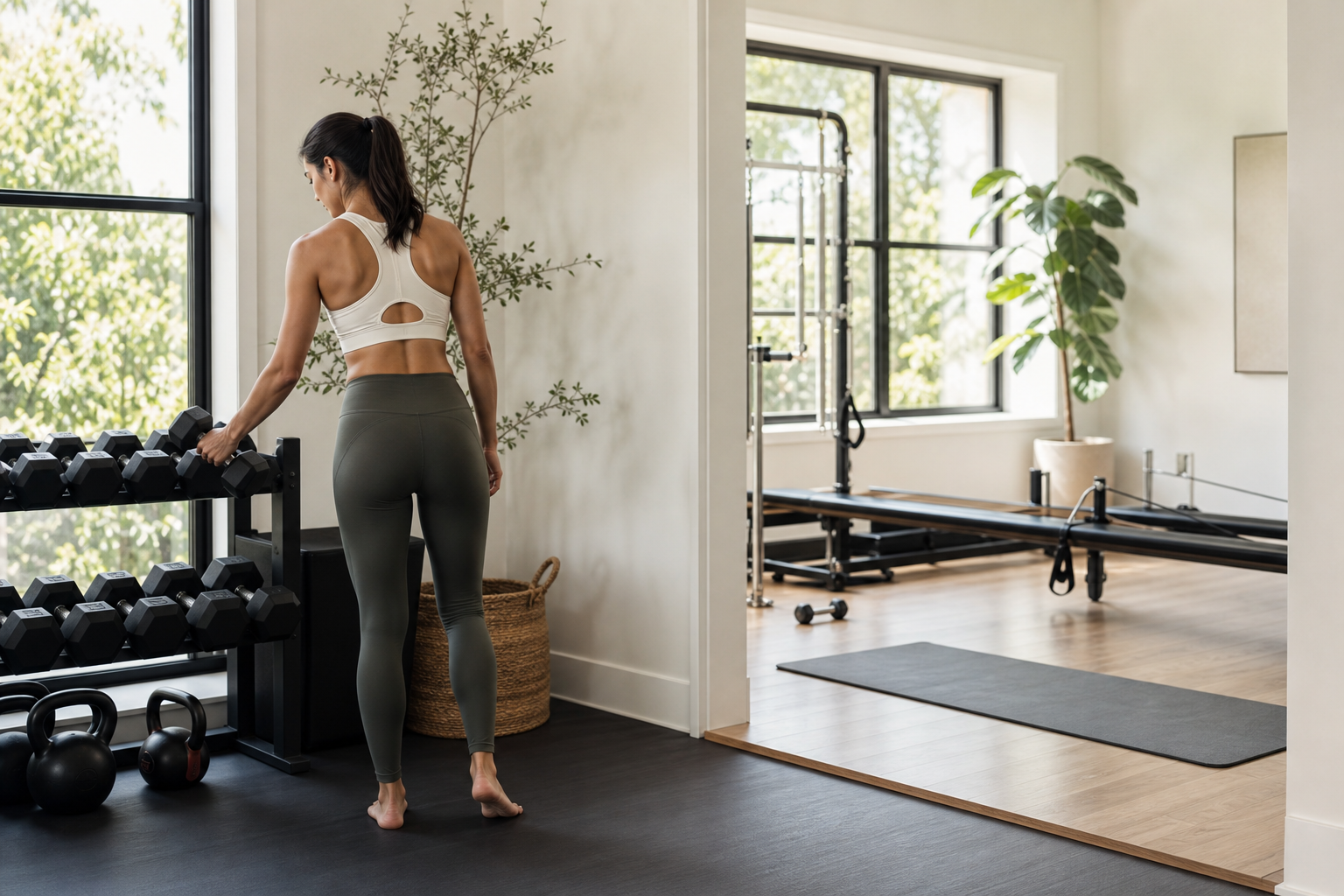
The 3 2 1 rule in the gym is a weekly workout formula that spread across TikTok and Reddit in early 2023: three strength training sessions, two Pilates sessions, and one cardio session, for six total workouts a week. It's presented as a balanced way to build muscle, improve mobility, and support heart health without overtraining any single system.
What most explanations skip is the practical part: how long each session should last, whether six sessions leaves enough recovery, whether it actually helps with weight loss, and whether it's backed by anything beyond a catchy name. This guide fills in those numbers, compares the 3-2-1 rule to the unrelated 5-3-1 strength program, and lays out a beginner-friendly version you can start this week.
What Is the 3 2 1 Rule in the Gym?
The 3 2 1 rule in the gym refers to a weekly training split made up of 3 strength sessions, 2 Pilates sessions, and 1 cardio session, six workouts total, leaving one day free for rest.
The idea is that each numbered block covers a different fitness pillar: strength for muscle and bone, Pilates for core control and mobility, cardio for cardiovascular endurance. The routine went viral on TikTok in 2023 as a low-impact alternative to daily high-intensity training, and it's since been adapted with different ratios (some people do 2 cardio and 1 Pilates day instead).
It's a scheduling template, not a certified program with a governing body or research trial behind the exact 3-2-1 name. That distinction matters for how much weight you should put on claims that it's scientifically superior to other splits, which the next sections unpack.
How Does a 3-2-1 Weekly Schedule Actually Fit Together?
A workable 3-2-1 week spaces the six sessions so no two hard days land back to back, with one full rest day at the end. Session length and intensity matter as much as the count, since six unstructured workouts can just as easily lead to burnout as balance.
Based on general exercise-guideline norms for session duration, a reasonable structure looks like this: strength sessions run 40 to 45 minutes at a moderate to hard effort (RPE 6 to 8 out of 10), Pilates sessions run 25 to 30 minutes at a moderate effort focused on control rather than fatigue, and the cardio session runs 30 to 45 minutes in a comfortable-but-working zone (roughly 60 to 70 percent of max heart rate).
| Day | Session | Duration | Intensity |
|---|---|---|---|
| Monday | Strength (upper body) | 40-45 min | RPE 6-7 |
| Tuesday | Pilates | 25-30 min | Moderate |
| Wednesday | Strength (lower body) | 40-45 min | RPE 6-7 |
| Thursday | Cardio | 30-45 min | Zone 2, 60-70% max HR |
| Friday | Pilates | 25-30 min | Moderate |
| Saturday | Strength (full body) | 40-45 min | RPE 7-8 |
| Sunday | Rest | - | - |
Notice the strength days alternate muscle groups so consecutive sessions don't hit the same tissue twice without recovery, a spacing principle backed by the American College of Sports Medicine's guidance on resistance training progression, which recommends at least 48 hours between sessions targeting the same muscle group.
Does the 3-2-1 Method Actually Work?
Parts of the 3-2-1 method line up with established exercise guidelines, but the combination itself has never been tested as a unit in any published study. The evidence is strongest for the strength and cardio pieces individually, and thinner for Pilates and for the specific 3-2-1 ratio.
The Centers for Disease Control and Prevention recommends adults get at least 150 minutes of moderate aerobic activity per week plus muscle-strengthening work on 2 or more days. Three strength days a week comfortably clears that bar. But one 30-minute cardio session only totals 30 minutes of aerobic work weekly, well short of the 150-minute target unless you stretch the session longer or the strength days also raise your heart rate meaningfully.
The World Health Organization's 2020 physical activity guidelines echo similar minimums and add that any amount of movement is better than none, which supports the general framework of 3-2-1 even if the specific split isn't studied. Pilates' benefits for core stability and mobility are documented in smaller trials, but it isn't classified under either the aerobic or strength categories in these major guidelines, so its contribution is real but harder to quantify against a public health standard.
What Is the 3 2 1 Rule in the Gym for Weight Loss?
The 3-2-1 rule in the gym for weight loss only works if it also creates a calorie deficit; the exercise split by itself doesn't guarantee fat loss. Weight loss is governed by energy balance, not by which workouts you choose.
According to the CDC's guidance on losing weight, a deficit of roughly 500 to 1,000 calories per day tends to produce about 0.5 to 1 kilogram (1 to 2 pounds) of loss per week. Six weekly workouts can help you burn more calories and preserve muscle while dieting, but if daily intake still exceeds what you burn, the scale won't move regardless of how balanced the split looks.
Where 3-2-1 genuinely helps with weight management is adherence: the variety of strength, Pilates, and cardio can make a workout habit easier to stick with than doing the same session every day, and consistency is what determines whether any deficit gets maintained long enough to show results.
What Is the 3 2 1 Rule in the Gym for Beginners?
The 3-2-1 rule in the gym for beginners should be scaled down, not attempted at full volume from week one. Six sessions a week with only one rest day is a heavy load for someone new to structured training.
A more realistic starting version drops to 4 total sessions for the first 4 to 6 weeks: 2 strength days, 1 Pilates day, and 1 cardio day, with 3 rest days spread through the week. Strength days should use bodyweight or light-resistance variations (squats, push-ups against a wall or bench, resistance-band rows) rather than heavy free weights, Pilates sessions can run 15 to 20 minutes instead of 30, and cardio should stay low-impact, brisk walking or a stationary bike rather than running.
Once that reduced version feels manageable for 3 to 4 straight weeks without excessive soreness or fatigue, you can add a third strength day and a second Pilates day to reach the full 3-2-1 template.
How Often Should You Do a 3-2-1 Workout?
The 3-2-1 structure is meant to repeat once per week as your standing template, not as a single workout you do once and move on from. Each week you cycle through the same 3 strength, 2 Pilates, 1 cardio pattern.
How you adjust the cadence depends on your goal. If you're training for endurance, bumping cardio to 2 sessions and dropping Pilates to 1 keeps total volume the same while shifting emphasis. If hypertrophy or strength is the priority, some people move to 4 strength days and 1 Pilates day, though this pushes weekly volume higher and makes recovery planning more important, since ACSM guidance suggests waiting at least 48 hours before retraining the same muscle group.
3-2-1 Rule vs. 5-3-1 Rule: Two Completely Different Systems
The 3-2-1 rule and the 5-3-1 rule are unrelated systems that happen to share a numbered-name format. Confusing them leads to a very different workout than what most searchers are actually looking for.
The 5/3/1 program was created by strength coach Jim Wendler as a percentage-based progression scheme for four main barbell lifts, squat, bench press, deadlift, and overhead press. Each training cycle runs sets of 5, then 3, then 1-plus reps at rising percentages of your one-rep max, detailed in Wendler's original 5/3/1 strength article. It has nothing to do with weekly session counts, Pilates, or cardio.
| Feature | 3-2-1 Rule | 5/3/1 Program |
|---|---|---|
| What it is | Weekly workout split | Strength progression scheme |
| Numbers mean | 3 strength / 2 Pilates / 1 cardio sessions | Rep targets (5, 3, 1+) across a training cycle |
| Main goal | Balanced, beginner-friendly fitness | Maximal strength in core barbell lifts |
| Origin | TikTok trend, 2023 | Jim Wendler, published 2000s |
If you saw the term in a strength-training forum discussing percentages and 1RM, you're likely reading about 5/3/1, not the gym split described here.
Is the 3-2-1 Method Just Hype? What Critics Say
The main criticism of the 3-2-1 method, common in Reddit fitness threads, is that it's a standard well-rounded training split with a catchy new name rather than a genuine innovation. Combining strength, mobility work, and cardio across a week is decades-old advice; the 3-2-1 label just makes it easy to remember and share.
A second, fair critique is volume: six sessions with a single rest day can be too much for someone new to exercise, especially if strength days aren't spaced with enough recovery, risking soreness or early burnout before habits form. A third point is that no peer-reviewed study has tested the specific 3-2-1 ratio against other splits, so claims that it's uniquely effective outrun the evidence.
None of that means the method is useless. The value is mostly structural: it gives beginners a simple mental model and built-in variety, which can improve adherence even without proof that this exact ratio outperforms alternatives.
A Sample 3-2-1 Weekly Workout Plan You Can Actually Use
Here is a full-week template with named exercises, meant as a text-based alternative to the generic PDF templates that circulate online. Adjust sets, reps, and load to your current fitness level.
Monday, strength (upper body), 40 minutes: push-ups or bench press 3x10, dumbbell rows 3x10, overhead shoulder press 3x10, bicep curls 2x12, plank 3x30 seconds.
Tuesday, Pilates, 25 minutes: hundred, roll-up, single-leg circles, side leg lifts, spine stretch, saw, cat-cow flow.
Wednesday, strength (lower body), 40 minutes: goblet squats 3x10, Romanian deadlifts 3x10, walking lunges 3x12 per leg, glute bridges 3x15, calf raises 2x15.
Thursday, cardio, 30 minutes: brisk walk, jog, or cycling at a pace where you can still hold a conversation.
Friday, Pilates, 25 minutes: similar flow to Tuesday with added side plank and swimming exercise.
Saturday, strength (full body), 45 minutes: deadlifts 3x8, push press 3x10, pull-ups or lat pulldowns 3x10, step-ups 3x10 per leg, farmer's carry 3x30 seconds.
Sunday: rest, or light stretching if desired.
Frequently asked questions
How often should you do a 3-2-1 workout?
It's designed to repeat weekly as your standard template: 3 strength, 2 Pilates, and 1 cardio session every week, with 1 rest day. You can adjust the ratio slightly (more cardio or more strength) depending on your specific goal, but the pattern is meant to be ongoing, not a one-time routine.
Does the 3-2-1 method actually work?
The individual components align with established exercise guidelines from the CDC and WHO for strength and aerobic activity, but no research has specifically tested the 3-2-1 combination. It can work as a sustainable structure, largely because it's easy to follow and varied, not because the exact ratio has been proven superior.
What is the 5-3-1 rule in the gym?
The 5-3-1 rule, more accurately called the 5/3/1 program, is a percentage-based strength training scheme created by Jim Wendler for squats, bench press, deadlifts, and overhead presses. It's completely unrelated to the 3-2-1 weekly workout split and focuses on rep and percentage progression instead of session variety.
Is the 3-2-1 method good for weight loss?
It can support weight loss by adding structured activity and burning calories, but the split itself doesn't force weight loss without a calorie deficit. Pairing the routine with a modest daily calorie reduction, around 500 calories per the CDC's guidance, is what actually drives fat loss.
What is the 3 2 1 rule in the gym for beginners?
For beginners, a lighter version works better: 2 strength days, 1 Pilates day, and 1 cardio day, using bodyweight exercises and shorter sessions, with 3 rest days built in. This reduces the risk of overtraining before building up to the full 6-session version.
Is there a 3 2 1 rule in the gym PDF?
Most PDF results online are landing pages rather than full plans. The day-by-day schedule and named exercises in this guide's sample week can be copied or printed as a practical, ready-to-use alternative.