
A gym abs workout differs from the mat-only circuits that dominate search results because it gives you machines and loaded resistance that let you keep progressing long after bodyweight moves stop working. This guide covers the four movement patterns worth training on a gym floor, how to load each one, and how often to train them without stalling recovery.
You'll also get clarity on the McGill Big 3 versus a separate mass-building trio, a realistic six-pack timeline tied to body fat percentage, and the two safety cues for weighted crunch machines and hanging leg raises that no other ranking page currently addresses.
What is the best abs workout for a gym setting?
The best gym abs workout combines four movement patterns you can't easily load at home: weighted flexion, rotation under resistance, anti-extension stability, and hanging leg raises, each hitting a different part of the midsection with more resistance than a bodyweight circuit allows.
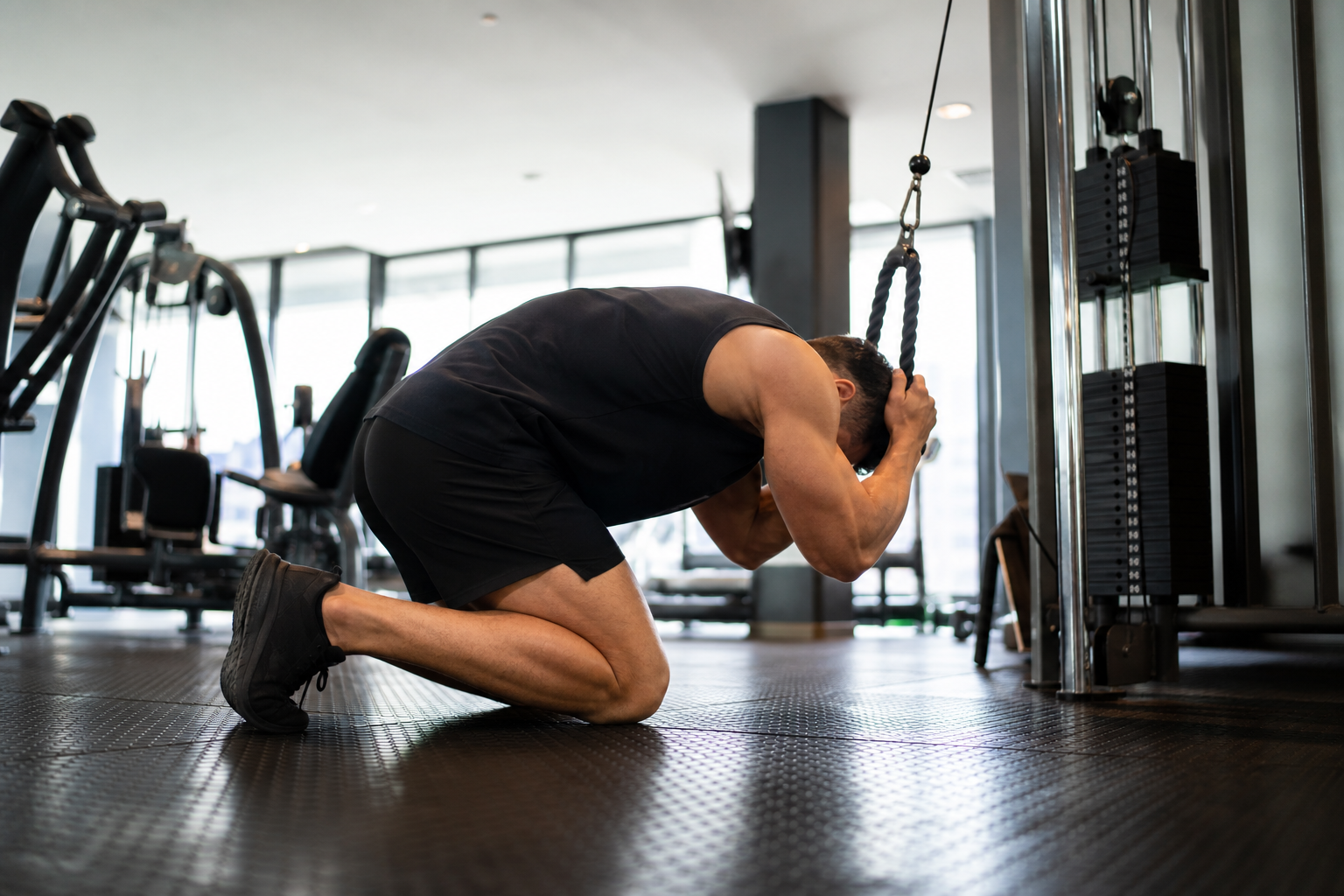
Start with a loaded flexion movement like the cable crunch: kneel in front of a high pulley with a rope attachment behind the neck and curl the torso down toward the thighs while keeping the hips still. This isolates the rectus abdominis under continuous tension, unlike a bodyweight crunch. Begin with 3 sets of 12-15 reps at a weight that brings you close to failure by the last rep.
Add a rotation movement such as the cable woodchop, pulling the handle diagonally from a high anchor point across the body to knee height. This trains the internal and external obliques through rotation rather than the side bends most home routines rely on. Three sets of 10-12 reps per side is a reasonable starting point.
Include an anti-extension or stability hold, either a weighted plank with a plate on the upper back or an ab wheel rollout, both of which train the transverse abdominis to resist movement rather than create it. Two to three sets of 30-45 seconds, or 8-10 controlled rollouts, is enough to start.
Finish with a hanging leg raise from a pull-up bar or dedicated station, which loads the lower rectus abdominis and hip flexors through a full range of motion no floor exercise replicates. Three sets of 8-12 reps, adding ankle weights once bodyweight reps stop feeling challenging, completes the four-movement template.
What are the 'Big 3' ab exercises?
The term "Big 3" refers to two different things depending on context, and knowing which one you mean changes your training entirely.
In the spine-health and rehabilitation world, the Big 3 comes from Canadian spine biomechanics researcher Dr. Stuart McGill, detailed in his textbook Ultimate Back Fitness and Performance. His three exercises, the curl-up, the side plank, and the bird dog, are chosen specifically to build core stability while minimizing spinal flexion load, making them the standard recommendation for anyone managing disc or lower-back issues rather than a hypertrophy circuit.
In gym and bodybuilding contexts, "Big 3 ab exercises" usually means a different, mass-building trio: the cable crunch, the hanging leg raise, and the weighted decline sit-up. These three load the rectus abdominis directly through resistance and a full range of motion, which is what most gym-goers searching for visible ab size are actually asking about.
If your priority is spine health or existing back pain, follow McGill's version. If your priority is building visible ab muscle in a gym, the loaded trio above, already built into the four-movement framework, is the more relevant "Big 3."
Abs workout equipment: what's actually on the gym floor
The right abs workout equipment lets you load the midsection the way you already load your legs or chest, something a mat alone can't do. Below is what you'll actually find on a gym floor, plus which of the four muscle groups (transverse abdominis, rectus abdominis, internal obliques, external obliques) each one hits hardest.
The cable crunch machine (a high pulley with a rope attachment) is the best abs workout machine for progressive overload: you kneel facing away from the stack and crunch down against resistance, so the weight increases exactly like a bench press would. A seated plate-loaded ab machine does the same flexion pattern from a fixed seat, useful for beginners who need the seatback for lumbar support. The Roman chair, also called a captain's chair, uses forearm pads and hangs the legs free; an ACE-sponsored EMG study ranked captain's chair leg raises among the most effective ab exercises tested, ahead of the standard crunch.
A hanging leg raise station (a pull-up bar or dedicated tower) demands more grip and shoulder stability and shifts load toward the transverse abdominis and hip flexors. Decline benches let you anchor your feet and add a weight plate to your chest for loaded sit-ups. The ab wheel, often tucked near the mats, trains anti-extension: rolling out and back without letting the lower back sag.
| Equipment | Primary muscle group | Beginner note | Progressed note |
|---|---|---|---|
| Cable crunch machine | Rectus abdominis | Start with 3 sets of 12-15 at a light stack weight | Add 5-10 lb per week once form holds |
| Seated ab machine | Rectus abdominis | Use back support, moderate range | Slow the negative to 3 seconds |
| Roman/captain's chair | Obliques, rectus abdominis | Knee raises, no swing | Straight-leg raises or add ankle weights |
| Hanging leg raise station | Transverse abdominis, hip flexors | Bent-knee raises, controlled tempo | Straight-leg raises to toes-to-bar |
| Decline bench | Rectus abdominis | Bodyweight sit-ups, 15-20 reps | Hold a weight plate across the chest |
| Ab wheel | Transverse abdominis, rectus abdominis | Roll out from the knees, short range | Roll out from standing for full extension |
Is 20 minutes of abs a day too much?
Twenty minutes of ab work is not too much on its own, but doing it every single day usually is once you're using load. The rectus abdominis and obliques are skeletal muscle, the same tissue category as your quads or lats, and the Physical Activity Guidelines for Americans recommend spacing muscle-strengthening work on the same muscle group across non-consecutive days to allow recovery.
This is exactly why the single 2-3x/week figure shows up in home-workout guides: bodyweight circuits are low-load, so they can be trained a bit more often than a loaded gym session without much recovery cost. Once you add cable crunches, weighted decline sit-ups, or hanging leg raises with ankle weights, the abs need the same 48-hour window as any other trained muscle.
There's a second reason daily heavy ab work backfires in a gym setting: your abs already do isometric work on every squat, deadlift, and overhead press. Stacking a fatigued core onto a heavy squat day raises injury risk and can weaken your bracing under the bar.
A practical split: dedicated loaded ab work twice a week, for example after a leg day and after a push day, with the pull day left free or used for the McGill Big 3 (light, spine-friendly movement rather than heavy flexion).
How do you get a six-pack in 3 months?
Three months is enough time only if your body fat is already within roughly 5-8 percentage points of visible-ab range; no exercise, gym or home, burns fat specifically off the stomach.
This is the spot-reduction fallacy. A controlled trial published in the Journal of Strength and Conditioning Research had participants train obliques with high-volume resistance exercise for six weeks and found no significant reduction in fat over the trained area compared to the untrained side. Ab exercises build the muscle underneath; whether that muscle shows depends on the fat layer above it, which responds to total energy balance, not local training.
Visible abdominal definition generally requires around 10-15% body fat for men and 18-22% for women, according to the ACE body composition chart. Reaching that range on top of the training outlined above depends on a sustained calorie deficit, typically around 500 kcal per day, which produces roughly one pound of fat loss per week according to standard energy-balance guidance from the CDC.
Do the math against your own starting point. Someone starting near 16-18% body fat can plausibly reach visible abs in 12 weeks on a consistent deficit. Someone starting at 25% or higher is unlikely to get there in three months without an unsustainably aggressive deficit that risks muscle loss; a realistic timeline for that starting point is closer to five to seven months.
Home abs workout vs. gym abs workout: what actually changes?
The 10-move mat circuit that dominates home ab content is a legitimate, well-designed session; nothing about it needs replacing. What changes at the gym is progression headroom. Bodyweight circuits plateau once the moves feel easy, whereas cable stacks, plate-loaded machines, and hanging leg raise stations let you add resistance in small increments for years, which is what actually keeps the rectus abdominis and obliques adapting once bodyweight reps stop being a challenge.
Is loaded ab machine and hanging leg raise training safe?
Yes, loaded ab machine and hanging leg raise training is safe for most healthy lifters when two form cues are respected. On a weighted crunch machine, rest your hands lightly against your head or the pads rather than gripping and yanking; pulling on the neck transfers load to the cervical spine instead of the rectus abdominis. On a hanging leg raise station, brace your shoulders and avoid letting momentum swing your legs, since an uncontrolled kip shifts stress into the lumbar spine rather than the abs.
Anyone with an existing disc injury or chronic low-back pain should skip heavy spinal flexion machines altogether and favor McGill's Big 3, which train core stability without repeated bending under load.
Frequently asked questions
Do I need to do cardio for visible abs, or is the abs workout enough?
No, the abs workout alone won't reveal abs without a calorie deficit, and cardio isn't mandatory as long as diet keeps you in that deficit. Some people close the deficit through food alone, others prefer adding cardio because it makes the math easier. Either path works as long as the deficit stays consistent over weeks, not days.
What weight should I start with on a cable crunch machine?
Start with a weight that lets you complete 12-15 controlled reps with a full spinal curl, which for most beginners is 20-30% of what they'd use on a lat pulldown, since the rectus abdominis is a much smaller muscle than the lats. Add 5-10 pounds once 15 reps feel easy with strict form. Most people start too heavy and end up yanking from the hip flexors instead of curling from the abs.
Can I combine gym ab machines with the bodyweight circuit I already do at home?
Yes, but not on the same day at full volume for both. The mat circuit and gym machine work fatigue the same abdominal muscles, so stacking two full sessions back to back risks overtraining without added benefit. A practical split is the bodyweight circuit at home once a week and loaded gym work twice a week, spaced at least 48 hours apart.
Do women need a different abs workout approach than men?
No, the exercises, loading, and progression are identical; what differs is the body fat percentage needed for visibility. Women generally need roughly 18-22% body fat to see visible abs versus 10-15% for men, due to essential fat differences rather than training differences. Every frequency and progression recommendation in this guide applies the same way regardless of sex.
Should I train abs before or after my main lift that day?
After, in nearly every case. Training abs before squats, deadlifts, or overhead presses pre-fatigues the core's ability to stabilize the spine under heavy load, which raises injury risk on the main lift. Save loaded ab work for the end of a session or program it on a day separate from your heaviest lifts.
Sources
- Stuart McGill, BackFitPro (2023)
- ACE-sponsored research: Abdominal exercises (2001)
- Physical Activity Guidelines for Americans, 2nd edition (2018)
- Regional Fat Changes Induced by Localized Muscle Endurance Resistance Training (2013)
- ACE body composition chart (2023)
- CDC losing weight guidance (2023)