
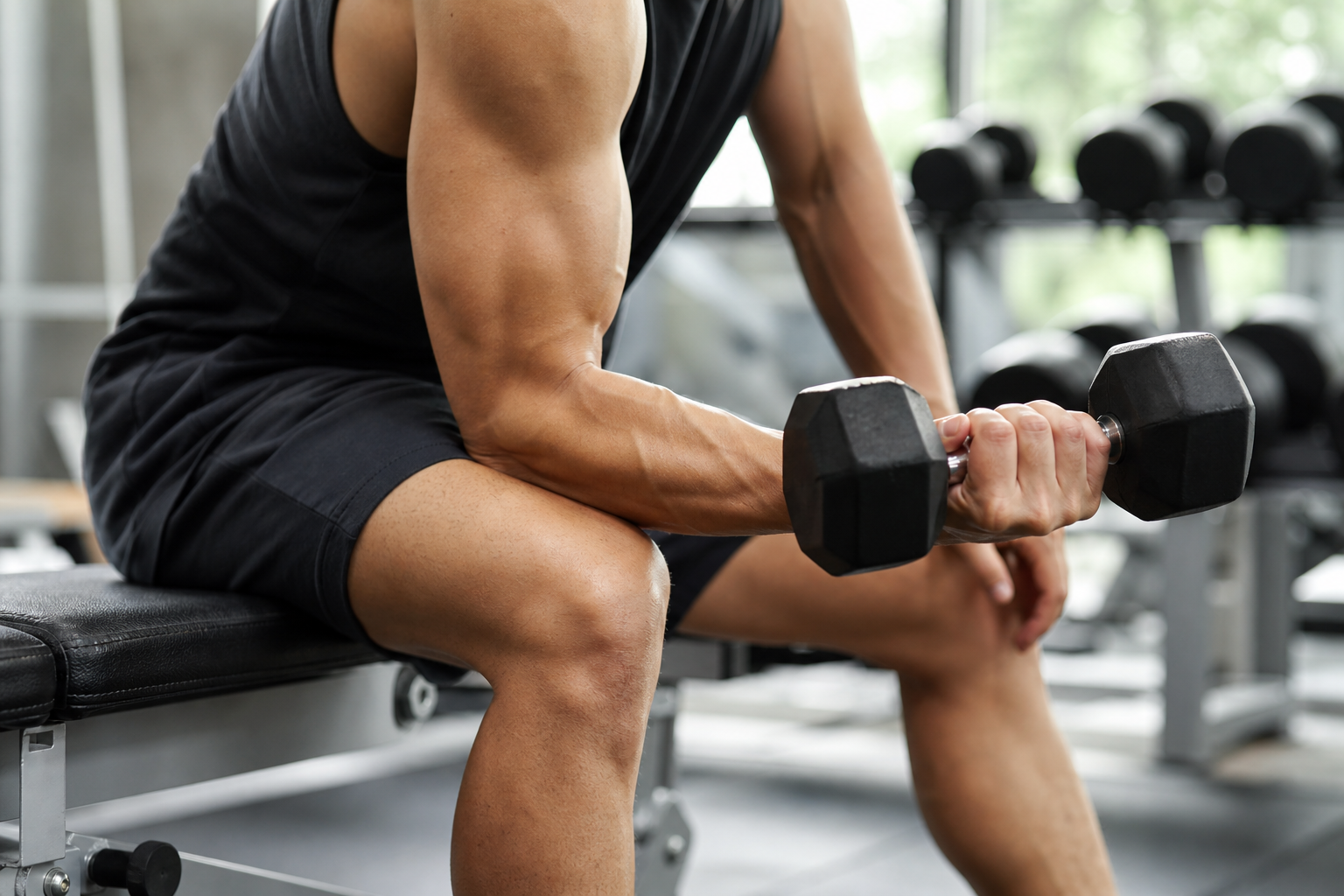
A well-built forearm workout with dumbbells does more than add size, it builds the grip strength that carries over to deadlifts, pull-ups, and everyday tasks like carrying groceries or opening jars. This guide gives you seven specific dumbbell exercises with sets, reps, rest periods, and starting loads, plus shorter versions for beginners, home lifters, and anyone short on time.
You'll also get direct answers on how much is actually enough, how fast you can expect visible change, and how the plan shifts (or doesn't) for women and true beginners.
What Makes This the Best Forearm Workout With Dumbbells?
The farmer's carry is the single non-negotiable move in this list, because grip strength trained under a real, shifting load transfers to daily life and other lifts in a way that no seated wrist curl can match. Grip strength is even used in research as a general marker of muscular health, which is a strong argument for building the workout around it rather than treating it as an afterthought.
The other six exercises exist to fill gaps the carry leaves open. Wrist curls and reverse wrist curls balance the flexors on the palm side against the extensors on the back of the hand, since training one and ignoring the other creates strength imbalances at the wrist. Hammer curls, reverse curls, and Zottman curls add rotational and elbow-flexion work the carry does not train, and the wrist roll finishes with radial-ulnar deviation, a movement pattern the other six exercises skip entirely.
The 7-Exercise Forearm Workout With Dumbbells (With Sets and Reps)
Each exercise below targets a different part of the forearm, so skipping one leaves a gap rather than just doing "less" of the same thing. Pick your starting dumbbell weight off a movement you already know, a comfortable hammer curl weight, since every other load in this table is set as a percentage of that number.
| Exercise | Target | Sets x Reps | Rest | Cue | Starting Load |
|---|---|---|---|---|---|
| Wrist Curl | Flexors (palm side) | 3 x 12-15 | 45-60 sec | Forearms rest on thighs, palms up, curl using only the wrist | 40-50% of your hammer curl weight |
| Reverse Wrist Curl | Extensors (back of hand) | 3 x 12-15 | 45-60 sec | Same setup, palms down, lift the knuckles toward the ceiling | 20-25% of your hammer curl weight, extensors are weaker |
| Farmer's Carry | Grip and full forearm | 3 x 30-40 meters | 60-90 sec | Walk tall, shoulders back, dumbbells at your sides, do not let them swing | A pair you can hold with a solid grip for 30 seconds before form breaks |
| Hammer Curl | Brachioradialis and grip | 3 x 10-12 | 60 sec | Curl with palms facing each other the whole rep | Your reference weight, the one every other load is based on |
| Reverse Curl | Extensors and brachioradialis | 3 x 10-12 | 60 sec | Palms down grip, curl without letting the wrists break | 60-70% of your hammer curl weight |
| Zottman Curl | Flexors and extensors together | 3 x 10 | 60 sec | Curl palms up, rotate palms down at the top, lower slowly | 50-60% of your hammer curl weight |
| Wrist Roll | Grip and radial-ulnar deviation | 3 x 10 rolls each direction | 60-90 sec | Arm extended, roll the wrist side to side, resist the swing | A single 5-10 lb dumbbell, control matters more than load here |
Rest intervals lengthen for the farmer's carry because grip fatigue accumulates fast and a rushed second set almost always ends in dropped dumbbells rather than a clean walk. If a exercise feels easy at the top of its rep range for two sessions in a row, that is the signal to move up in weight, not before.
Is 3 Exercises Enough for a Forearm Workout With Dumbbells?
Yes, 3 exercises are enough for grip maintenance and general forearm health, but not enough if your goal is visible forearm size. A minimum effective dose is wrist curls plus reverse wrist curls plus farmer's carries, done twice a week for 3 sets each. This combination hits both flexors and extensors and adds a loaded-carry component, covering the three movement patterns that matter most for grip strength and everyday wrist stability.
The full 7-exercise version earns its place only when hypertrophy is the actual goal, or when you have been training grip for 6+ months and the basic 3 no longer feel challenging. Advanced lifters and anyone chasing bigger forearms, not just a stronger grip, need the extra volume and exercise variety (hammer curls, reverse curls, Zottman curls, wrist rolls) to keep progressing. For most beginners and anyone short on time, 3 well-chosen moves beat 7 done halfheartedly.
How Do You Bulk Your Forearms With Dumbbells?
You bulk your forearms with dumbbells by progressively adding load or reps every 1-2 weeks and staying patient, since forearm muscle responds slower to training than larger muscle groups. Once you can complete 3 sets of 15 reps with good form on a given exercise, add 2.5 to 5 pounds and drop back to the bottom of your rep range, or add 2 reps before adding weight if your dumbbells only jump in large increments. This kind of gradual, planned overload is the same principle laid out in the NSCA's progression models for resistance training, and it applies just as much to an 8-pound wrist curl as it does to a barbell squat.
Realistically, expect 8 to 12 weeks of consistent training before you see measurable circumference or vein visibility changes, since forearm flexors and extensors are smaller and slower to hypertrophy than biceps or quads. Some of this timeline is genetic: people with longer forearm muscle bellies and shorter tendon insertions build visible size faster, while those with long tendons and short muscle bellies (a common "high insertion" pattern) will always look leaner there regardless of training volume. That's an anatomical ceiling, not a program failure, so track strength (heavier dumbbells, more reps) as your primary progress marker, not just how your forearms look in the mirror.
Forearm Workout With Dumbbells for Beginners: Where to Start
True beginners should start with just two exercises: the wrist curl and the reverse wrist curl. These two moves teach control of wrist flexion and extension before you add the grip demands of a farmer's carry or the coordination needed for a Zottman curl. Delay the carry, Zottman curl, and wrist roll until you can complete the basic curls with clean form for several sessions in a row.
Start with 3 to 5 lb dumbbells regardless of general fitness level elsewhere in your training. Forearm flexors and extensors are small muscles that fatigue fast, so ego lifting here just breaks form. Two checkpoints matter most: the wrist should move through its complete range (fully curled up, fully released down) and the elbow should stay pinned to a bench or thigh so the upper arm never swings to help.
A simple four-week ramp:
- Week 1: 2 sets of 12 reps, 3 to 5 lb
- Week 2: 3 sets of 12 reps, same weight
- Week 3: 3 sets of 15 reps, same weight
- Week 4: add 2.5 lb once 15 clean reps are achieved for two straight sessions
Once that progression feels manageable, introduce the hammer curl and farmer's carry in week 5.
Is a Forearm Workout With Dumbbells Different for Women?
A forearm workout with dumbbells is not fundamentally different for women, only the starting load typically shifts lighter, with the same progression rules applying to everyone. Most women beginners do well starting 2 to 3 lb lighter than the general beginner range, for example 2 to 3 lb for wrist curls and 5 to 8 lb for hammer curls, then following the same overload pattern of adding small weight once the top of the rep range is hit for two sessions in a row.
The concern about forearms getting bulky from dumbbell training is understandable but not well supported by physiology. Women typically circulate roughly 10 to 20 times less testosterone than men, which is the primary hormonal driver of rapid muscle size gains. Practically, this means added forearm size from this kind of training is slow and modest, showing up as firmer, stronger forearms over months rather than sudden bulk.
A realistic 15-minute routine: wrist curl, 3 sets of 15 reps; reverse wrist curl, 3 sets of 15 reps; hammer curl, 3 sets of 12 reps; farmer's carry, 3 rounds of 30 seconds. Done 2 to 3 times per week, this covers flexor, extensor, and grip work without needing the full 7-exercise session every time.
Forearm Workout With Dumbbells at Home: What If Your Weights Aren't Heavy Enough?
Yes, home dumbbells that top out at 20 to 25 lb can still build real forearm size and grip strength if you change tempo and rep scheme instead of just adding plates. Forearm muscles respond well to time under tension, so slowing the eccentric (lowering) phase of a wrist curl or reverse wrist curl to 3 to 4 seconds forces the same fibers to work harder even at a fixed light load.
Add a 2 to 3 second isometric hold at full wrist flexion or extension before reversing the movement. This end-range pause increases mechanical tension without needing a heavier dumbbell.
For farmer's carries and hammer curls, switch to single-arm loading: hold one dumbbell and work each side separately, which lets you effectively double the resistance per hand compared to splitting the same total weight across two dumbbells. Pushing rep ranges up to 20 to 25 reps per set on wrist curls and reverse curls also compensates for a low weight ceiling.
Because forearms recover faster than larger muscle groups, this adjusted routine still fits a 2 to 3 times per week schedule at home, either as a standalone 15-minute session or tacked onto an existing pull or arm day.
Frequently asked questions
Can dumbbell forearm exercises help with tennis elbow or golfer's elbow?
Light, controlled wrist curls and reverse wrist curls are commonly used in rehab for both conditions, but only once acute pain has settled and a clinician has cleared loading. The <a href="https://orthoinfo.aaos.org/en/diseases--conditions/tennis-elbow-lateral-epicondylitis/">standard rehab approach</a> for tennis elbow relies on slow, eccentric-focused wrist extension work, which overlaps with the reverse wrist curl in this list. Golfer's elbow follows the same logic but targets the flexor side, so a slow wrist curl fits better. Skip any exercise that reproduces sharp elbow pain and build load gradually instead of jumping straight to the sets and reps given for healthy lifters.
Should I train forearms before or after my main lifts like deadlifts or pull-ups?
Train forearms after your main lifts, not before. Pre-fatiguing your grip with wrist curls or farmer's carries before a heavy deadlift or pull-up session will limit the weight you can safely handle on those bigger movements. Save this forearm workout for the end of a session or for a separate day so grip fatigue never becomes the limiting factor on a compound lift.
Can you overtrain your forearms by doing dumbbell curls every day?
Yes, daily training without any rest can blunt progress even though forearms recover faster than larger muscle groups. Two to three sessions per week with a day of rest between them is enough to drive adaptation without accumulating the kind of fatigue that shows up as persistent tightness or a weakening grip. If your grip feels noticeably weaker session to session rather than stronger, that is a sign to add an extra rest day.
Do forearm dumbbell exercises actually improve grip strength for climbing or sports?
Yes, but with a caveat: dumbbell work builds general grip and forearm endurance, while climbing and racket sports also demand sport-specific grip patterns like crimping or racket-handle control. The farmer's carry and wrist curl variations in this workout build the base strength that supports those specific skills, but they should supplement, not replace, sport-specific grip training for serious climbers or players.
Is it better to use a barbell instead of dumbbells for wrist curls?
Neither is better outright, they train the same muscles differently. A barbell allows heavier total load and is convenient for bilateral wrist curls, while dumbbells allow each wrist to move through its own natural range and correct side-to-side strength imbalances. If you already own dumbbells and don't have easy barbell access, there is no strength or size disadvantage to sticking with dumbbells for this workout.
How sore should my forearms be after a first dumbbell forearm workout?
Mild soreness lasting one to two days is normal and expected after a first forearm session, similar to <a href="https://www.physio-pedia.com/Delayed_Onset_Muscle_Soreness">delayed onset muscle soreness</a> anywhere else in the body. Sharp pain, swelling, or soreness that lasts more than three days is not normal and suggests the starting load or volume was too high. Scale back the weight or sets next session and let soreness guide your progression rather than pushing through it.