
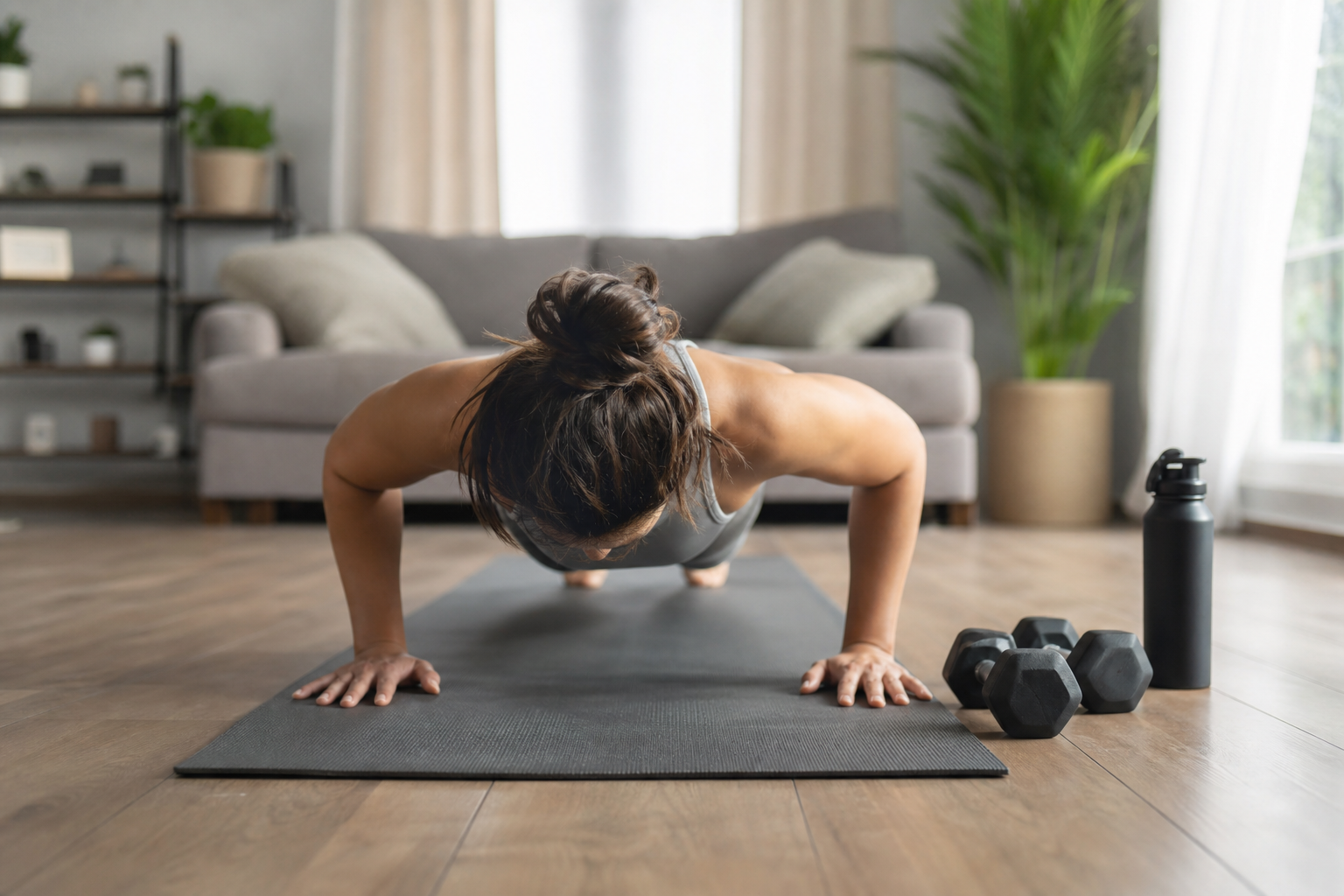
If you're weighing a best workout routine at home against a gym membership, the short version is that a well-built home plan can produce the same strength and fitness gains as a gym routine, as long as it follows the same rules that make any program work: progressive overload (gradually increasing the demand on your muscles), adequate rest, and consistency over months, not days.
What most fitness pages skip is the part that actually makes a plan usable: what to do when strength goals and cardio goals want different rest periods, whether daily exercise routines contradict twice-weekly training guidelines, and how to keep progressing once bodyweight squats stop being hard. This article covers the standard beginner template briefly, then spends most of its time on those exact gaps, including the 3-3-3 rule, a genuine no-equipment progression system, and whether a routine "for men" is actually different from any other plan.
The Core Principles Behind Every Effective Home Workout
The most effective workouts at home and the most effective workout routine anywhere share the same three ingredients: compound movements, progressive overload, and enough recovery between sessions that hit the same muscle group. A compound movement, one that works several muscle groups and joints at once, such as a squat or a push-up, gives you more training benefit per minute than an isolation exercise like a bicep curl.
Progressive overload means the workout gets slightly harder over time, whether that's an extra rep, an extra set, a slower tempo, or a harder variation of the same movement. Without it, your body has no reason to adapt, regardless of whether you're training in a gym or a living room. This is the piece that separates a routine that works from one that just feels busy.
Public health guidance from the CDC and the World Health Organization both recommend at least 150 minutes of moderate aerobic activity weekly plus muscle-strengthening work on 2 or more days. That guidance is the floor, not the ceiling, and it's built into every plan below.
What Is the Best Workout Routine at Home for Beginners?
The best workout routine at home for beginners is a full-body session repeated three times a week on non-consecutive days (Monday, Wednesday, Friday works well), alternating between two slightly different workouts so the same joints and muscles aren't loaded identically every session.
A beginner is generally defined as someone with under a year of consistent training experience. At this stage, almost any reasonable full-body program produces results, so the priority is technique and showing up, not exotic exercise selection.
| Day | Exercise | Sets x Reps | Rest |
|---|---|---|---|
| A | Goblet squat | 3 x 8-10 | 90 sec |
| A | Push-up (incline if needed) | 3 x 8-12 | 90 sec |
| A | Bent-over dumbbell row | 3 x 8-10 | 90 sec |
| A | Romanian deadlift | 2 x 8-10 | 90 sec |
| A | Plank | 3 x 30-45 sec | 60 sec |
| B | Reverse lunge (per leg) | 3 x 8-10 | 90 sec |
| B | Standing shoulder press | 3 x 8-10 | 90 sec |
| B | Glute bridge | 3 x 12-15 | 60 sec |
| B | Renegade row (per side) | 2 x 8 | 90 sec |
| B | Side plank (per side) | 2 x 20-30 sec | 60 sec |
Run Day A on Monday and Friday and Day B on Wednesday in week one, then flip the order the following week. A beginner following this exactly will complete roughly 20 to 25 working sets per week, which is well within the range that produces measurable strength gains within 4 to 6 weeks for someone new to training.
What Is the 3-3-3 Rule for Working Out?
The 3-3-3 rule is not a peer-reviewed training principle; it's a fitness-content shorthand that circulates in at least two different versions, and neither has controlled research behind it as a standalone method.
The version most relevant to home strength training uses 3 exercises, done for 3 sets each, 3 times a week, usually applied to a specific body part like abs or arms as a minimalist add-on to a bigger routine. A second version, more common in wellness content, refers to walking for 3 minutes after a meal, 3 times a day, to help blunt post-meal blood sugar spikes.
Neither version is wrong, but neither is a substitute for a structured full-body program either. If you see "3-3-3" attached to a home workout plan, treat it as a simple add-on rule of thumb (3 exercises, 3 sets, 3 days) rather than a complete routine on its own, and check whether the source means the training version or the walking version before following it.
Strength Rest vs Circuit Rest: Building a Balanced Home Week
Home fitness content gives two different rest-period numbers because it's describing two different goals, not because the sources disagree. Strength-focused routines use 90 to 180 seconds of rest on main lifts because your muscles and nervous system need that time to recover enough to lift close to your best effort again. Circuit training, a format that strings exercises together with short recovery to keep the heart rate elevated, uses about 20 seconds between exercises and a full minute between rounds because the goal is metabolic stress and cardiovascular demand, not maximal strength output.
| Goal | Rest Between Sets | Rest Between Rounds | Best For |
|---|---|---|---|
| Strength (main lift) | 90-180 sec | N/A | Squats, presses, rows, deadlifts |
| Strength (accessory) | 60-90 sec | N/A | Lunges, calf raises, curls |
| Circuit/metabolic | 15-20 sec | 60 sec | Bodyweight circuits, runners, general conditioning |
If your week includes both goals, don't mix the rest periods within the same session. A practical split is three strength days (Monday, Wednesday, Friday) using the longer rest periods from the beginner table above, plus one or two circuit sessions (Tuesday or Saturday) using the short-rest format for conditioning. Doing both in the same 30-minute block usually shortchanges one goal to serve the other.
Can You Really Do 7 Exercises Every Day?
Yes, but only if the daily version is light and the muscle-building version stays at 2 to 4 sessions a week; "do these 7 exercises every day" content and the "strength train at least twice weekly" guidance are not actually contradictory once you separate intensity from frequency.
A daily 7-exercise routine done at low effort (mobility work, bodyweight squats without added load, light planks) functions as movement maintenance, similar to the 20 to 30 minutes of daily activity recommended by the CDC. It doesn't create enough muscular fatigue to require the 48 to 72 hours of recovery that progressive strength training does.
The twice-weekly minimum from the American College of Sports Medicine's position stand refers specifically to resistance training taken close to fatigue, the kind that builds new muscle and strength. If your "daily 7" routine leaves you close to failure on any exercise, that muscle group needs a rest day before you load it hard again, even if you keep moving lightly on the days between.
Building a No-Equipment Progression: Workout at Home Without Equipment
A workout at home without equipment can still follow progressive overload; the trick is changing leverage, tempo, and stability demands instead of adding weight plates. Most equipment-free content stops at circuit-style cardio because it doesn't quantify how to make bodyweight squats or push-ups harder once they stop being challenging, which is the actual gap for anyone past their first few weeks.
| Movement | Level 1 | Level 2 | Level 3 | Level 4 |
|---|---|---|---|---|
| Push | Incline push-up, 3 x 12 | Standard push-up, 3 x 12-15 | Tempo push-up (3 sec down), 3 x 10 | Archer push-up, 3 x 6-8/side |
| Squat | Bodyweight squat, 3 x 15 | Tempo squat (3 sec down), 3 x 12 | Bulgarian split squat, 3 x 10/leg | Assisted pistol squat, 3 x 5/leg |
| Row/pull | Doorframe or table row, 3 x 12 | Slow-eccentric row, 3 x 10 | Single-arm towel row, 3 x 8/side | Negative pull-up (if a bar is available), 3 x 5 |
Stay on a level for 2 to 3 weeks before moving up, and only progress once you can complete every set with 1 to 2 reps left in reserve. A comparative study on upper-body training found that push-up and bench press training produced [similar strength gains](https://pubmed.ncbi.nlm.nih.gov/25932981/) when taken to comparable levels of muscle activation, which supports treating bodyweight progressions as a genuine substitute for loaded lifts, not a lesser version of them.
Is There a Best Workout Routine at Home for Men?
No, there is no physiologically distinct best workout routine at home for men; the exercise selection, sets, and reps that build strength work the same way regardless of sex, and content labeled "for men" is almost always the same full-body template with different marketing framing.
Where a genuine difference shows up is relative load and recovery capacity, not exercise choice. On average, men carry more lean muscle mass and can typically handle slightly higher absolute training volumes before hitting the same level of fatigue, but the program structure, three full-body days for beginners, progressive overload, 60 to 180 seconds of rest, stays identical.
If you compare a generic beginner routine to a men's version on most fitness sites, you'll usually find the same squat, push-up, row, and hinge pattern with cosmetic changes like exercise photos or slightly heavier suggested starting weights. Sex-specific programming matters more at advanced levels of competitive strength or physique training than it does for anyone starting a home routine.
Moving From Beginner to Intermediate: What Actually Changes at Home
Moving from beginner to intermediate at home means adding sets, not just adding weight, since limited dumbbell ranges make simple load increases harder to sustain long term. Most trainees plateau on a basic full-body plan somewhere between 6 months and a year, and the fix at home looks slightly different than it does with access to a full rack of plates.
Concretely, this means shifting from 2 to 3 sets per exercise to 3 to 4 sets, narrowing the rep range on your heaviest lifts to 6 to 8 while keeping accessory work at 10 to 15, and moving from a 3-day full-body split to a 4-day upper/lower split so each muscle group gets slightly more weekly volume. A useful marker from Schoenfeld and colleagues' [meta-analysis on training frequency](https://pubmed.ncbi.nlm.nih.gov/27102172/) is that hitting each muscle group twice a week tends to outperform once-weekly training for hypertrophy, which is a strong argument for the 4-day split over adding more exercises to the same 3 days.
Where a gym-based intermediate would simply add more weight to the bar, at home you'll often need to combine heavier dumbbells (if you have an adjustable set) with the tempo and unilateral progressions from the no-equipment table above to keep creating enough overload.
Does a 6-Day Gym Workout Schedule Work at Home?
A 6-day gym workout schedule can work at home, but usually only if you already have a reasonably full set of adjustable dumbbells or a bench, since a push/pull/legs split repeated twice a week needs enough exercise variety to avoid repeating the same three movements six days running.
Without that equipment, cramming 6 days of training into a bodyweight-only setup tends to just repeat the same push-up and squat variations with diminishing returns, and recovery quality drops because there's no easy way to vary the joint angles and loading the way a cable machine or barbell rack allows. For most home trainees, a 4-day upper/lower split or the 3-day full-body plan above will outperform a forced 6-day schedule.
If you do want to run 6 days at home, split it as 3 upper body days and 3 lower body days, alternating so no muscle group trains on consecutive days, and treat 2 of the 6 as lighter, higher-rep sessions rather than max-effort days to manage recovery.
Frequently asked questions
What are the most effective workouts at home?
Full-body strength sessions built around squats, push-ups, rows, and hip hinges, done 3 times a week with progressive overload, are the most effective home workouts for building strength and muscle. For cardio and conditioning, short-rest bodyweight circuits (about 20 seconds between exercises) are the most efficient equipment-free option.
Do I need any equipment to get real results at home?
No. A structured bodyweight progression using tempo changes and unilateral variations (single-leg or single-arm versions of an exercise) can produce meaningful strength gains without dumbbells, though a pair of adjustable dumbbells does make progressing past the intermediate stage easier.
How many days a week should a beginner train at home?
Three non-consecutive days a week (such as Monday, Wednesday, Friday) using full-body sessions is the standard recommendation for beginners, allowing 48 hours of recovery between sessions that stress the same muscle groups.
Is a home workout routine actually different for men versus women?
Not in exercise selection or program structure. The main practical difference is that men, on average, can typically handle somewhat higher training loads and volumes before reaching the same fatigue point, but the underlying plan stays the same.
How long until a home workout routine shows results?
Most beginners notice strength improvements within 4 to 6 weeks and visible changes in muscle tone within 8 to 12 weeks, assuming consistent training 3 times a week and adequate protein intake.
Can I combine the 3-3-3 rule with a full-body routine?
Yes, treating it as a small add-on works fine: pick 3 accessory exercises, do 3 sets of each, 3 days a week, layered onto your main full-body sessions rather than replacing them.
Sources
- Physical Activity Basics for Adults (2023)
- Physical activity fact sheet (2022)
- Quantity and Quality of Exercise for Developing and Maintaining Cardiorespiratory, Musculoskeletal, and Neuromotor Fitness in Apparently Healthy Adults: Guidance for Prescribing Exercise (ACSM Position Stand) (2011)
- Effects of Resistance Training Frequency on Measures of Muscle Hypertrophy: A Systematic Review and Meta-Analysis (2016)
- Bench Press and Push-up at Similar Levels of Muscle Activity Results in Similar Strength Gains (2015)