
The best workout routine for beginners is a structured, full-body strength plan you can repeat at least three days a week, one that tells you exactly how much weight to add, when to add it, and how to know it's working, not just a list of exercises to try. If you've read three articles and still don't know whether to add 2 pounds or 20, or what "5-3-1" even means, you're not alone, and it's not your fault: most beginner content stops at "increase the weight gradually" and leaves the actual numbers out.
This is also a commercial search: you're probably weighing a free routine against a paid app or PDF before you spend money or time. The short version is that a beginner needs three things a program can't fake: a repeatable structure, a simple way to track sets and reps, and a rule for when to push harder. Everything below gives you those three things with real numbers, plus home and gym versions mapped to each other, so you can start today.
What Makes the Best Workout Routine for Beginners Actually Work?
The best workout routine for beginners is the one you can repeat consistently for at least six weeks while adding a small, measurable challenge in almost every session.
That definition rests on three things, not exercise selection. First, adherence: a plan you can do on a Tuesday when you're tired beats a perfect plan you skip. Second, injury prevention: loads and volume that match your current capacity, not your ambition. Third, measurable progression, meaning you can point to a number this week that's higher than last week's number.
Public health guidance backs the frequency piece specifically. The CDC recommends muscle-strengthening activity on 2 or more days a week for all major muscle groups, which is the floor, not the ceiling, for a true beginner plan.
Progressive overload, the practice of gradually increasing weight, reps, or sets so your muscles keep adapting, is the mechanism behind all of this. Without it, a routine just maintains whatever fitness level you started at.
A Good 3-Day Beginner Workout Routine
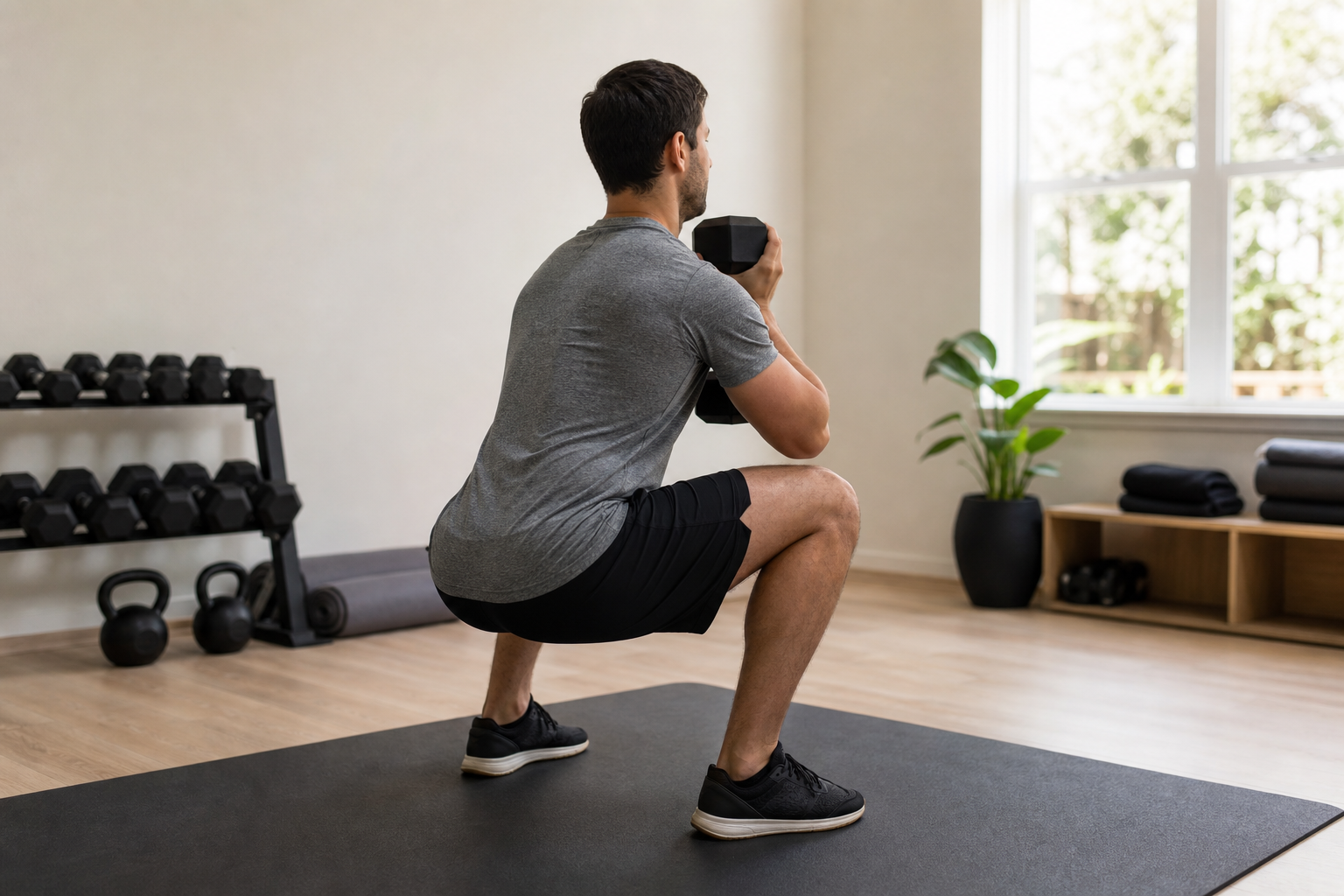
A good 3-day beginner workout routine trains the whole body each session using five movement patterns: squat, hinge, push, pull, and core. Repeating full-body sessions three times a week (rather than splitting body parts across more days) gives beginners more total practice with each movement, which matters more than volume when you're still learning form.
Rest 60 to 90 seconds between sets. Rest 48 hours between sessions (for example, Monday, Wednesday, Friday) so muscles recover before the next full-body load.
| Pattern | Exercise | Sets x Reps | Rest |
|---|---|---|---|
| Squat | Goblet squat | 3 x 10 | 90 sec |
| Hinge | Dumbbell Romanian deadlift | 3 x 10 | 90 sec |
| Push | Push-up (or incline push-up) | 3 x 8-12 | 60 sec |
| Pull | Dumbbell row | 3 x 10 per side | 60 sec |
| Core | Plank | 3 x 20-30 sec | 45 sec |
RPE, short for Rate of Perceived Exertion, is a 1-10 scale for how hard a set feels, where 10 is a maximal all-out effort. Beginners should aim for an RPE of 6 to 7, meaning you could still do 3 to 4 more reps if you had to.
What Do the "3-3-3," "5-3-1," and "2-2-2" Gym Rules Mean?
These three rules are unrelated to each other and only one of them fits a true beginner. The 5-3-1 rule is an intermediate strength program, the 2-2-2 rule is a maintenance guideline, and the 3-3-3 rule is closest to a beginner's minimalist structure.
The 3-3-3 rule, as most beginner programs use the term, means three workouts a week, three main exercises per session, three sets of each. It's essentially a simplified version of the full-body plan above, useful if you want the absolute minimum structure to start.
The 5-3-1 rule refers to Jim Wendler's 5/3/1 program, which cycles a lifter's training weights across waves of 5 reps, 3 reps, and 1 rep based on a percentage of their tested max. It assumes you already know your one-rep max on the squat, bench, and deadlift, which a true novice doesn't have yet and doesn't need. Save 5-3-1 for after your first 3 to 6 months of consistent training.
The 2-2-2 rule is typically used as a minimum-maintenance guideline: at least 2 training days a week, 2 exercises per muscle group, 2 sets minimum, enough to hold onto strength during a busy stretch, not enough to build it. It's a floor for maintenance, not a target for a beginner trying to progress.
Progressing Week to Week: The Missing Numbers
Add 2.5 to 5 pounds to upper-body lifts and 5 to 10 pounds to lower-body lifts once you complete every set at the top of your rep range for two sessions in a row. This matches the general load-increase range described in the American College of Sports Medicine's position stand on resistance training progression, which suggests roughly 2 to 10 percent increases for novice lifters depending on the exercise.
Here's what that looks like using the goblet squat from the sample routine, assuming a 20 lb dumbbell in week 1:
| Week | Goblet Squat | Sets x Reps | Change Trigger |
|---|---|---|---|
| 1-2 | 20 lb | 3 x 10 | Learn form, hit RPE 6-7 |
| 3 | 25 lb | 3 x 10 | Hit 3 x 10 easily twice |
| 4 | 25 lb | 3 x 12 | Add reps before adding weight |
| 5 | 30 lb | 3 x 10 | Hit 3 x 12 easily twice |
| 6 | 30 lb | 3 x 12, add 4th exercise | Ready for more volume |
Around week 6, if you're recovering well and sessions feel manageable, that's the point to add a 4th exercise per session or a 4th training day, not before.
What Does a Beginner Workout Routine Look Like at Home?
A beginner workout routine at home uses the same five movement patterns as the gym version, substituted with bodyweight or dumbbell moves at matched difficulty. You don't need a rack or a machine to run the same progression numbers from the table above; you just need a pair of adjustable dumbbells or resistance bands.
| Pattern | Home Version | Gym Version |
|---|---|---|
| Squat | Dumbbell goblet squat | Leg press or barbell back squat |
| Hinge | Dumbbell Romanian deadlift | Barbell Romanian deadlift or hip thrust machine |
| Push | Push-up, incline push-up | Dumbbell bench press or chest press machine |
| Pull | Dumbbell row, band row | Lat pulldown or seated cable row |
| Core | Plank, dead bug | Cable crunch or ab machine |
The progression trigger stays identical: once you can do all sets at the top of your rep range for two sessions in a row, add weight (a heavier dumbbell) or add resistance (a thicker band), following the same 2.5-5 lb upper body and 5-10 lb lower body increments.
What Does a Beginner Workout Routine Look Like at the Gym?
A beginner workout routine at the gym uses the same patterns but swaps in machines or barbells once bodyweight and light dumbbells stop feeling challenging. Machines are a reasonable starting point in a gym setting because they control the movement path, which lowers the technical learning curve while you build confidence under a bit more load.
A practical rule: start on a machine or dumbbell version of a lift for your first 4 to 6 weeks, then move to the free-weight or barbell version once you can complete the full rep range with good control and an RPE of 6 to 7. For example, move from the leg press to a goblet squat to a barbell back squat, in that order, rather than starting under a loaded bar in week one.
Gym equipment also lets you increase weight in smaller true increments (many gyms have 2.5 lb plates), which matters for the upper-body progression numbers in the table above, since dumbbells at home often jump in 5 lb steps.
Is the Best Workout Routine for Beginners Different for Women?
No, the base program is the same because skeletal muscle responds to resistance training the same way regardless of sex; sets, reps, and the progression numbers above don't need to change for a woman versus a man starting from the same fitness level.
What can shift slightly is recovery and energy across the menstrual cycle. A 2020 systematic review in Sports Medicine examining the effect of menstrual cycle phase on exercise performance found the impact on strength and power output was small and inconsistent across studies, meaning most women won't need to restructure their training week around it, though some notice lower perceived energy in the days right before their period and may prefer to schedule a lighter session then.
The other real difference is injury-risk awareness, not programming: research consistently shows women have a higher rate of ACL injury in sports involving cutting and landing, which is a reason to prioritize controlled squat and hinge mechanics early, a detail true for the exact program above, not a separate one.
So a "workout plan for beginners female" search should lead back to the same 3-day routine, just without the marketing repackaging.
Building a Printable Workout Log When No PDF Fits
A workout log only needs six fields to be useful: date, exercise, sets, reps, weight used, and RPE, plus a notes column for how the session felt. You can build this in a notebook or a spreadsheet in under five minutes; it doesn't require a purchased template.
Example row: March 4, Goblet Squat, 3 x 10, 25 lb, RPE 7, "felt controlled, ready to add weight next session." Three weeks of rows like this tell you exactly when you hit the progression trigger from the table above, which a generic downloaded PDF can't do because it doesn't know your numbers.
| Free (self-tracked log) | Paid app or program ($10-30/mo) | |
|---|---|---|
| Structure | Yes, from a plan like this one | Yes, usually pre-built |
| Progression math | You calculate it (simple, shown above) | Often automated |
| Coaching cues / form checks | No | Sometimes, via video |
| Cost over 6 weeks | $0 | $15-45 |
For a true beginner, the thing worth paying for is coaching or form feedback, not the tracking sheet itself; the numbers in this article cover the tracking and progression math for free.
When Should You Modify or Stop the Routine?
Stop or modify a session when pain is sharp, one-sided, or lasts beyond 72 hours; normal beginner soreness is dull, appears on both sides of the body, and fades within 48 to 72 hours.
This distinction has research behind it. Work on muscle damage and repeated training bouts in novice lifters, including findings on resistance training-induced adaptations in untrained adults, shows that soreness naturally drops off within the first few weeks as the muscle adapts to a new stimulus, known as the repeated bout effect, even without changing the workout.
Practical red flags to actually stop and reassess: pain that gets worse during the set rather than after, swelling or bruising around a joint, or a lift that gets noticeably weaker for two sessions in a row instead of progressing. Any of those warrant dropping the weight back, resting an extra day, or checking form with a trainer, rather than pushing through on schedule.
Frequently asked questions
What is the 3-3-3 rule for working out?
In most beginner contexts it means three workouts a week, three main exercises per session, and three sets of each exercise. It's a minimalist structure meant to make starting simple, not a formal program with a single official source.
What is the 5-3-1 rule in the gym?
It's Jim Wendler's 5/3/1 program, which cycles training weight across waves of 5, 3, and 1 reps based on a percentage of your tested one-rep max. It's built for intermediate or advanced lifters who already know their max lifts, not for someone in their first few months of training.
What is the 2-2-2 rule in the gym?
It's generally used as a minimum-maintenance guideline: at least 2 training days a week, 2 exercises per muscle group, and 2 sets each. It's meant to preserve strength during a busy period, not to build new strength as a beginner program would.
How many days a week should a true beginner train?
Three non-consecutive days a week, such as Monday, Wednesday, Friday, is enough to build strength while giving muscles 48 hours to recover between full-body sessions. The CDC's minimum recommendation is 2 or more days of muscle-strengthening activity weekly, so 3 days sits comfortably above the floor without overreaching.
Is a home workout routine as effective as a gym routine for beginners?
Yes, as long as you can load the same five movement patterns (squat, hinge, push, pull, core) and apply the same progression numbers. Dumbbells or resistance bands are enough for the first several months; machines and barbells become more useful once you need smaller weight increments than a dumbbell set allows.
How long until a beginner sees results?
Most beginners notice better form, energy, and slightly easier sets within 2 to 3 weeks, with visible strength gains (heavier weight for the same reps) by week 4 to 6 if the progression numbers above are followed consistently. Visible body composition changes typically take longer, often 8 to 12 weeks.
Sources
- Physical Activity Basics for Adults, CDC (2023)
- Progression Models in Resistance Training for Healthy Adults, ACSM Position Stand (2009)
- Effects of Menstrual Cycle Phase on Exercise Performance, Sports Medicine (2020)
- Resistance Training-Induced Changes in Muscle Protein Synthesis and Damage in Novices (2016)