If you searched for the best alternative for coffee to stay awake, you probably already know what caffeine does to you: the 2pm crash, the jittery hands, the 11pm ceiling stare. What most lists never tell you is how much caffeine you're actually trading for when you switch to matcha, yerba mate, or a mushroom latte, or whether any of the "boosts energy" claims on the label have a study behind them.
This is a decision guide, not another list. It ranks the common substitutes by caffeine content, evidence quality, and who they're actually appropriate for, including the two groups every other page skips: people on ADHD medication and people who just want their coffee ritual back with less of the drug in it.
The Best Alternative for Coffee to Stay Awake: A Quick Decision Guide
There isn't one best alternative for coffee to stay awake because "stay awake" means different things to different people: less jitteriness, an ADHD-safe option, zero caffeine, or just a different taste. The right pick depends on which problem you're actually solving.
The FDA's ceiling of 400mg of caffeine per day for most healthy adults is the backdrop for every choice below, but it's a ceiling, not a target. Someone getting crashes at 250mg a day needs a lower-dose swap, not just a different-flavored version of the same 250mg.
Use this framework: if you want less caffeine but still some, go to the mg comparison below. If you're managing ADHD medication, skip to that section before you change anything. If you want zero stimulant at all, the non-caffeine protocols have actual timing numbers. If you just miss the ritual, decaf is the answer nobody else mentions.
How Much Caffeine Is Really in Matcha, Yerba Mate, and Kombucha?
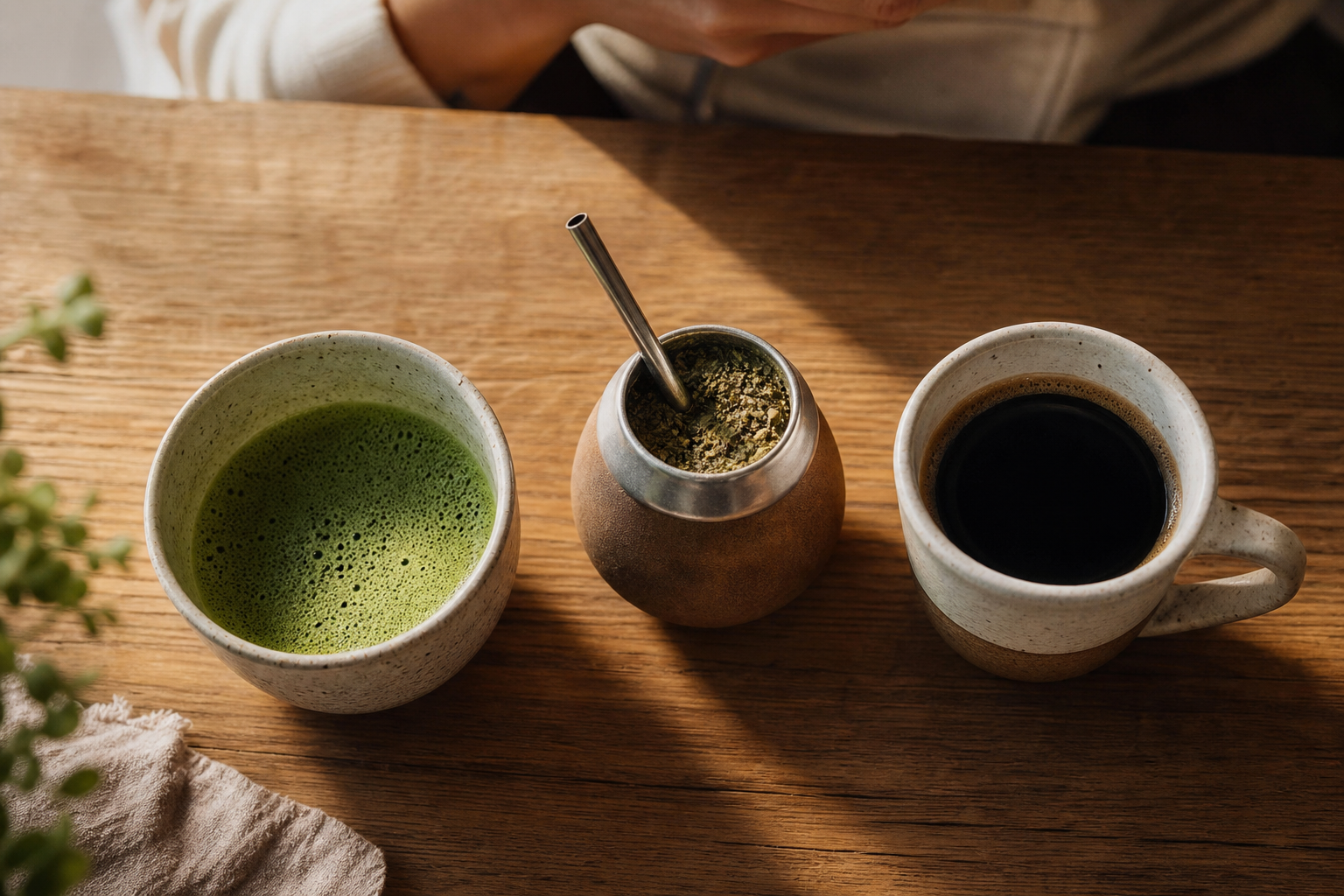
Matcha and yerba mate are not caffeine-free, they're lower-dose. An 8oz cup of matcha (about 1 teaspoon of powder whisked into water) delivers roughly 35-70mg of caffeine, while the same size cup of yerba mate delivers 65-130mg, compared with about 95mg in a standard 8oz brewed coffee, according to Mayo Clinic's caffeine content chart.
Kombucha is the outlier people assume is stimulating and mostly isn't: an 8oz serving typically has 8-15mg, since most of the tea's original caffeine is consumed during fermentation. Guarana, the seed used in many energy blends, runs 40-80mg of caffeine per gram of raw extract, which is why a single guarana supplement capsule can match or beat a cup of coffee despite looking tiny.
| Drink (8oz serving) | Caffeine (mg) | Notes |
|---|---|---|
| Brewed coffee | ~95 | Reference point |
| Yerba mate | 65-130 | Cap at 1-2 cups/day |
| Black tea | 40-70 | Milder crash than coffee |
| Matcha | 35-70 | Contains L-theanine |
| Green tea | 25-45 | Lowest of the true teas |
| Kombucha | 8-15 | Residual, ferment-dependent |
| Rooibos, peppermint, ginger, chicory | 0 | Caffeine-free by nature |
The practical takeaway: swapping a full coffee for a matcha latte cuts your caffeine roughly in half, not to zero. If you're chasing an actual caffeine-free option, rooibos, peppermint, ginger, and roasted chicory root are the only entries on that list that qualify.
What's the Best Caffeine Substitute If You Have ADHD?
There is no single best caffeine substitute for ADHD, because the safest move depends on whether you're currently on stimulant medication. Caffeine and prescribed stimulants like methylphenidate or amphetamine salts work on overlapping pathways, and stacking them can add up to more heart rate and anxiety than either one alone, which is why any change should go through your prescriber rather than a wellness article.
The evidence on caffeine and attention in ADHD itself is thin and mixed. A small controlled study of children with ADHD found caffeine produced modest improvements on some cognitive measures, but the effect was far weaker and less consistent than approved stimulant medication, and it hasn't been established as a reliable substitute in adults.
Separately, in healthy (non-ADHD) adults, a 2010 trial found that combining roughly 200mg of L-theanine with 160mg of caffeine improved attention-switching accuracy and reduced the jitteriness caffeine alone caused. That's why matcha, which naturally pairs caffeine with L-theanine, is a reasonable lower-jitter option to discuss with a prescriber, but it is not a validated ADHD treatment and shouldn't replace medication decisions made with a clinician.
Practical rule: if you take stimulant medication, don't add or drop caffeine sources without asking your prescriber first, especially if you have any cardiac history. If you're caffeine-sensitive but not on medication, capping intake at 100mg from a matcha or half-strength yerba mate is a reasonable starting point to test tolerance.
Staying Awake Without Caffeine: Light, Cold, and Naps by the Numbers
You can stay awake without any caffeine, but it takes a specific protocol rather than willpower. Three tactics have actual timing data behind them: light exposure, cold exposure, and short naps.
Morning light exposure, ideally 10 minutes of direct outdoor sunlight or 20-30 minutes under a 10,000-lux light box within the first hour of waking, suppresses melatonin and sharpens alertness within roughly 30-60 minutes, according to sleep researchers studying circadian light response. This works even on a cloudy day since outdoor light is still far brighter than indoor lighting.
Cold exposure, a 30-60 second cold water splash on the face or a brief cold shower, triggers a reflexive spike in heart rate and alertness that typically lasts 20-30 minutes. It's a short bridge, not a substitute for sleep, but useful before a meeting or a drive.
Naps have the best data of the three. A widely cited NASA fatigue study found a 26-minute nap improved task performance by 34% and alertness by 54% in sleep-deprived pilots. The window matters: stay under 20-30 minutes and take it before 3pm, since longer naps push you into deep sleep and cause grogginess (sleep inertia) instead of relief.
A 10-minute brisk walk still helps, mainly by raising heart rate and body temperature, but it's a smaller and shorter-lived effect than any of the three above.
Do Maca, Ginseng, and Mushroom Blends Actually Boost Energy?
Some of these claims have preliminary clinical support, and some are traditional use dressed up as science. They shouldn't be lumped together the way most coffee-alternative lists lump them.
| Ingredient | Traditional claim | What's actually been studied |
|---|---|---|
| Maca root | Centuries of Andean use for stamina and libido | One small trial (8 male cyclists) found 2g/day for 14 days improved time-trial cycling performance versus placebo; not replicated at scale |
| Panax ginseng | Used across East Asian medicine for vitality | A 364-person trial found 2,000mg/day modestly reduced cancer-related fatigue over 8 weeks; not tested for everyday daytime alertness in healthy adults |
| Mushroom blends (cordyceps, lion's mane, reishi) | Marketed as "adaptogens" for energy | Some cordyceps studies show modest exercise-oxygen changes at 3-4g/day over 3-6 weeks; no trials support acute alertness or "staying awake" claims specifically |
The honest summary: maca and ginseng have small, real studies behind narrower claims (cycling output, cancer-fatigue), not the broad "boosts stamina" language on most supplement labels. Mushroom blends have the least direct evidence for alertness specifically, despite being the most aggressively marketed.
Safety notes worth stating plainly: high-dose ginseng can interact with blood thinners and diabetes medication by affecting blood sugar and clotting, and maca's hormone-modulating history means it's generally avoided in pregnancy and by anyone on hormone-sensitive treatment. Chicory root's inulin fiber, often the base of coffee substitutes, can cause bloating and gas above roughly 5g/day in people not used to fermentable fiber. Yerba mate deserves one caveat too: observational studies in South America have linked very heavy, decades-long, scalding-hot mate consumption to higher esophageal cancer risk, but researchers attribute this mainly to drinking liquid at very high temperatures, not the plant itself, so a normal 1-2 cup daily habit at drinkable temperature isn't the same exposure.
Is Decaf the Best Alternative for Coffee to Stay Awake for Ritual Lovers?
If what you actually miss is the taste and the routine rather than the stimulant, decaf or half-caf coffee is the most overlooked answer, and no competing list on this topic mentions it. An 8oz cup of decaf coffee has roughly 2-15mg of caffeine, using Mayo Clinic's figures, compared with about 95mg in a regular cup, a reduction of over 85% while keeping the exact flavor and ritual you're used to.
Half-caf, a 50/50 blend of regular and decaf grounds, lands around 45-50mg per cup, close to what a cup of black tea delivers. This is a practical stepping stone for someone tapering down from multiple daily cups rather than quitting cold turkey, which is when most people report the worst withdrawal headaches.
One quality note: Swiss Water Process decaf removes caffeine using water and carbon filtration instead of chemical solvents, which matters to some buyers but doesn't change the caffeine numbers above. Either method gets you to roughly the same low-dose result.
Frequently asked questions
What kind of coffee is best for staying awake?
Any strongly brewed regular coffee works, roast level matters less than people think since light roasts actually retain slightly more caffeine by volume than dark roasts due to less time in the roaster. If you want to stay awake with less total caffeine, half-caf (around 45-50mg per 8oz) is a better strategy than switching roast color.
What can I replace coffee with for energy without a crash?
Matcha (35-70mg per cup) pairs caffeine with L-theanine, which several studies link to steadier alertness with fewer jitters than caffeine alone. Yerba mate is a stronger option at 65-130mg per cup if you still want a jolt closer to coffee's.
What can ADHD people use instead of caffeine?
There's no over-the-counter substitute proven equivalent to prescribed stimulant medication for ADHD symptoms. If you're managing caffeine intake alongside medication, talk to your prescriber before changing anything, since caffeine and stimulant drugs affect overlapping pathways and can compound side effects.
How do I force myself to stay awake without caffeine?
Use a short nap of 10-20 minutes before 3pm, get 10 minutes of direct sunlight within an hour of waking, or splash cold water on your face for 30-60 seconds. These have measurable data behind them, unlike willpower alone, but none of them substitute for actual sleep if you're chronically deprived.
Is a natural caffeine substitute like guarana actually safer than coffee?
Not automatically. Guarana still contains caffeine, often 40-80mg per gram of extract, so a supplement capsule can deliver as much or more caffeine than a cup of coffee despite being marketed as a natural alternative. Total mg is what matters, not the source.
Is decaf coffee a healthy alternative for coffee to stay awake?
Decaf is a reasonable middle ground if your goal is cutting caffeine rather than eliminating stimulation entirely, since it carries only 2-15mg per cup versus roughly 95mg in regular coffee. It won't help much if you specifically need alertness, but it solves the ritual and taste side of the habit.
Sources
- Spilling the Beans: How Much Caffeine Is Too Much (2022)
- Caffeine content for coffee, tea, soda and more (2023)
- The combination of L-theanine and caffeine improves cognitive performance and increases subjective alertness (2010)
- Effects of caffeine on cognitive, psychomotor, and affective performance of children with attention-deficit/hyperactivity disorder (2000)
- A pilot investigation into the effect of maca supplementation on physical activity and sexual desire in sportsmen (2009)
- Wisconsin Ginseng (Panax quinquefolius) to Improve Cancer-Related Fatigue: A Randomized, Double-Blind Trial (2013)
- Power Nap: How Long Should It Be? (2023)
- Light and Sleep (2023)