

If you have typed some version of "how can I integrate fitness into a busy lifestyle" into a search bar at 11 p.m. after a day that ate every spare minute, you are not looking for another 12-week program. You are looking for a system that survives contact with a full calendar, unpredictable shifts, or a toddler who does not care about your workout schedule.
This is not the usual list of "park farther away" tips, though a few of those still hold up. It is the actual numbers behind the minimum you need, what time-use surveys reveal about the minutes you already have, and specific comparisons for gyms, wellness centers, and workplace programs that most articles gloss over.
How Much Exercise Do You Actually Need When You're Busy?
The evidence-based floor is smaller than most people assume: about 150 minutes of moderate activity a week, or roughly 22 minutes a day, and it does not need to happen in one continuous block.
The World Health Organization's guidelines set that 150 to 300 minute range for moderate aerobic activity, half that for vigorous activity, plus two muscle-strengthening sessions a week. That is the whole target, not a starting point you have to double.
A 2022 study tracking over 25,000 adults in Nature Medicine found that people who fit in three to four bursts of vigorous effort a day, each lasting one to two minutes (a fast stair climb, a brisk uphill walk), had meaningfully lower rates of early death and cardiovascular events than people who did none of that. None of it required a gym bag.
Do You Really Have No Time, or No Priority?
Most adults have more unclaimed time than the word "busy" suggests; the shortage is usually one of priority, not raw minutes.
The American Time Use Survey from the Bureau of Labor Statistics consistently finds that U.S. adults spend around 5 hours a day on leisure and sports combined, with television and screen-based leisure making up more than half of that total on average. Twenty-two minutes, the WHO daily target, is a slice of a slice of that number.
Run a three-question audit before you decide you have no time: What did you do in the 30 minutes before you opened this article? Which recurring block this week (a show, a scroll session, work you keep doing past your actual deadline) could give up 20 minutes without you noticing in a month? And if the honest answer is "none," is that because the time truly does not exist, or because nothing has replaced it yet?
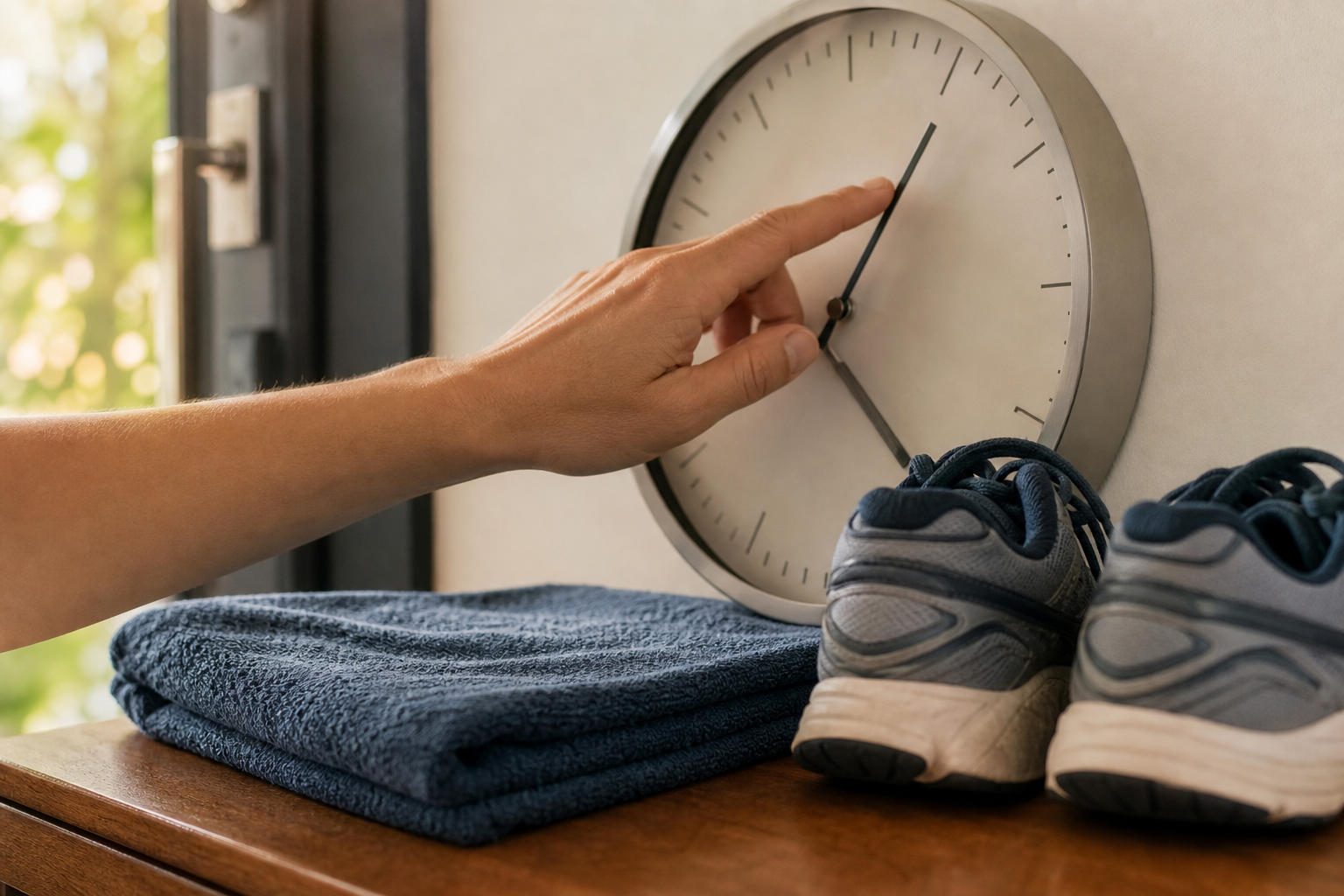
Everyday Ways to Integrate Fitness Into a Busy Lifestyle
The basics still work, so use them without overthinking: put workouts on your calendar at a fixed time the same way you would a meeting, since a floating intention to "exercise today" rarely survives a busy inbox.
Stack movement onto routines you already run on autopilot. Walk during phone calls that do not need a screen, take the stairs on the way to a meeting instead of before it, or do a set of squats while coffee brews. A 10 to 20 minute bodyweight circuit at home before you shower covers a full session without a commute.
A Minimum-Effective-Dose Weekly Template for a Chaotic Schedule
Here is a concrete week that clears the 150-minute threshold even if three of the seven days go sideways.
| Day | Session | Duration |
|---|---|---|
| Monday | Bodyweight circuit (squats, push-ups, rows, plank) | 20 min |
| Tuesday | Two brisk walks (commute or break) | 10 + 10 min |
| Wednesday | Stairs or bike intervals | 20 min |
| Thursday | Mobility or rest, plus 3 one-minute vigorous bursts | 5 min + snacks |
| Friday | Bodyweight circuit | 20 min |
| Saturday | Longer activity of choice (hike, sport, class) | 30 to 45 min |
| Sunday | Rest, or a walk if you want it | optional |
That structured total lands near 130 to 150 minutes before you count the daily one-minute bursts, which is exactly the range the guidelines ask for, distributed across a week that assumes at least one bad day.
Are Low-Cost Gym Memberships and Fitness Franchises Worth It for Busy People?
Yes, mainly because low commitment and flexible hours matter more to adherence than price once you are below about $40 a month.
A Planet Fitness membership runs roughly $10 to $15 a month for single-club access, or around $25 to $30 for the Black Card tier that adds any-location access and guest privileges, though hours and contract terms vary by location. Anytime Fitness memberships run higher, often $35 to $50 a month, but the trade is genuine 24-hour keyless access across most locations, which matters directly if your free hour lands at 5 a.m. or midnight.
| Option | Typical price | Access | Contract |
|---|---|---|---|
| Planet Fitness Classic | $10 to $15/mo | Home club, limited hours | Often month-to-month |
| Planet Fitness Black Card | $25 to $30/mo | All clubs, some 24-hr locations | Varies by location |
| Anytime Fitness | $35 to $50/mo | 24/7, most locations nationwide | Usually month-to-month after intro term |
| YMCA | $40 to $60/mo | Standard hours, broad classes | Month-to-month, family plans |
For a genuinely unpredictable schedule, the low $10 price tag has a real behavioral upside too: missing two weeks costs you almost nothing financially, which removes the guilt-driven urge to quit entirely instead of just picking back up.

What Should You Look for in a Fitness and Wellness Center Near You?
The right fitness and wellness center for a busy schedule is chosen by proximity to your actual route, not by amenities.
Search for a fitness and wellness center near you that sits between home and work or on your commute line, not just close to your house, since a location you only reach by making a special trip gets skipped first. Check the class schedule for spread across early morning, lunch, and evening slots rather than a single 6 p.m. window that assumes you leave work on time. Ask whether drop-in visits or short class packs are available instead of a 12-month commitment, and confirm the cancellation or freeze policy before you sign anything, since travel and shift changes are exactly when a rigid contract becomes a sunk cost you resent.
Can a Workplace Fitness and Wellness Program Actually Help?
Sometimes, modestly: workplace fitness and wellness programs increase participation in exercise for some employees, but the evidence on broader health savings is weaker than most employer marketing suggests.
A large multi-year RAND Corporation study of employer wellness programs found that participants who engaged with the exercise or lifestyle-management components did increase physical activity, yet the programs showed little measurable effect on overall health care costs over the study period. Roughly half of U.S. employers with 50 or more workers offer some form of wellness benefit, according to the same research, ranging from subsidized gym memberships to on-site classes.
If your employer does not have one, ask HR specifically about gym reimbursement, a flexible midday break for a walk or class, or an on-site 20-minute session during a lunch hour. Programs with real flexibility, not just a discount code, are the ones that actually change a busy week.
Fitness Strategies for Shift Workers, New Parents, and Multiple-Job Schedules
The default advice assumes a 9-to-5 office job, which fails entirely for a large share of busy people. A few adjustments make it workable.
Shift workers should anchor a session to wake-time, not clock-time, since "after I get up" is stable even when the calendar hour keeps rotating; a 24-hour gym or home circuit solves the access problem that fixed-hour gyms create. New parents can use nap windows for 10 to 15 minute segmented sessions, stroller walks that double as a nap-inducing routine, or split the day's total across two shorter blocks instead of chasing one uninterrupted hour that rarely exists. People juggling multiple jobs or on-call schedules do best keeping a small kit (resistance band, shoes) in a bag or car, so a session never depends on being near a specific facility when a rare 15-minute gap appears.
How Do You Actually Integrate Fitness Into a Busy Lifestyle for the Long Term?
You integrate fitness into a busy lifestyle for the long term by attaching it to a fixed daily cue and giving it two to three months before you judge whether it stuck.
Habits run on a cue-routine-reward loop: a stable trigger (coffee brewing, the kids leaving for the bus, closing your laptop at 6 p.m.) needs to come immediately before the workout, not a vague time of day. Pairing the plan with an explicit "if this, then that" statement, such as "if I close my laptop, then I put on my shoes," works better than a general intention to exercise more.
A widely cited study in the European Journal of Social Psychology tracked new habits and found it took an average of 66 days for a behavior to become automatic, with a real range of 18 to 254 days depending on the person and the habit's complexity. Expect the third and sixth week to feel like the habit isn't working yet. That is normal, not a sign to quit.
What's the All-or-Nothing Trap, and How Do You Escape It?
The trap is treating a missed 45-minute session as a failed day instead of doing the 10 minutes you actually have available.
Set a concrete floor before you need it: if the planned session cannot happen, do 10 minutes of any movement (bodyweight squats, a walk around the block, stairs in your building) and count it as a full win, not a consolation prize. Do not try to make up missed volume in the next session either; resume the plan as written. A single skipped day has a negligible effect on habit formation according to the same habit-tracking research, so the actual risk is not one missed workout, it is the two weeks of complete stoppage that follow when guilt takes over.
Frequently asked questions
Is a Planet Fitness membership worth it for a busy schedule?
For most time-pressed people, yes, mainly because the low price (roughly $10 to $30 a month depending on tier) makes occasional missed weeks financially painless rather than a reason to quit. Check whether your specific location offers 24-hour access or the Black Card multi-club tier, since standard single-club hours can be limiting for early or late schedules.
What are the best low-cost fitness franchises for irregular hours?
Anytime Fitness is the strongest option specifically for irregular or overnight schedules because most locations offer genuine 24/7 keyless access. Planet Fitness and Crunch Fitness are cheaper but hours vary more by location, so confirm access times before joining if your free hours fall outside a standard workday.
How do I find a fitness and wellness center near me that actually fits my schedule?
Look for one on your commute route rather than just near your home, check that classes run in early morning, lunch, and evening windows, and ask about drop-in visits or short class packs before committing to a long contract. A center with flexible cancellation terms matters more for a chaotic schedule than one with the most amenities.
Do workplace fitness and wellness programs actually increase activity?
Research from RAND Corporation found that employees who engage with the exercise components of workplace wellness programs do increase their activity levels, though the programs show weaker evidence for reducing overall health costs. Roughly half of larger U.S. employers offer some version of these programs, so it is worth asking HR what specific benefits, like gym reimbursement or flexible breaks, are actually available.
How long does it take to build a workout habit?
Research on habit formation found it takes an average of 66 days for a new behavior to feel automatic, with a realistic range of about 18 to 254 days depending on the person and the complexity of the habit. Missing a single day does not meaningfully disrupt that process, but extended stoppages do.
What if I only have 10 minutes a day for exercise?
Ten minutes of genuine effort, done consistently, is a legitimate floor rather than a failure, and it stacks with incidental movement like stairs or a brisk walk to approach the weekly 150-minute target over time. A short bodyweight circuit or a fast walk counts; the goal is showing up at the floor, not skipping the day because you cannot fit a full session.