
If you've typed 'how can I improve my flexibility and mobility' into a search bar after struggling to touch your toes or squat without your heels lifting, you're asking the right question at the wrong level of detail. Flexibility and mobility are related but not the same thing, they respond to different training, and progress happens on a more predictable schedule than 'just keep stretching and see.'
This guide gives you a real starting protocol: a 60-second test to find out which one is actually limiting you, a specific warm-up sequence, exact hold times, a realistic timeline broken into phases, and honest answers on age, food, and when stretching can actually cause harm.
What's the Difference Between Flexibility and Mobility?
Flexibility is how far a muscle and tendon can passively lengthen, like when someone else pushes your leg toward your chest. Mobility is how well a joint moves actively through its full range, under your own control, at the speed your daily life or workout demands. Most people who feel 'tight' are actually mobility-limited, meaning the tissue can lengthen fine, but the nervous system won't let the joint use that range without stability behind it.
Try this 60-second self-test before choosing exercises. Stand and try a slow toe touch: if your hamstrings feel like the wall stopping you, that's flexibility. Reach one arm overhead and behind your head to touch your opposite shoulder blade: if your shoulder shakes or you can't control the end range, that's mobility. Drop into a bodyweight squat: if your heels lift or your knees cave, ankle and hip mobility are the limiter, not muscle length.
| Trait | Flexibility | Mobility |
|---|---|---|
| Definition | Passive muscle/tendon length | Active, controlled joint range |
| Tested by | Assisted or relaxed stretch | Unassisted movement (squat, reach, lunge) |
| Improved by | Static stretching, held 30 sec to 2 min | Controlled articular rotations, loaded end-range work |
| Best frequency | 2-3x per week minimum | Daily, 5-10 minutes |
Most beginners need a mix of both, but if your self-test shows shaky control rather than a hard tissue block, spend more time on mobility drills than static holds.
How Can I Improve My Flexibility and Mobility: Best Beginner Stretches
A small set of stretches covers the joints people lose range in most often: hips, hamstrings, shoulders, calves, and the thoracic spine. Do these after a warm-up, holding each static position to the point of mild tension, never sharp pain.
| Stretch | Target area | Type | Hold / reps |
|---|---|---|---|
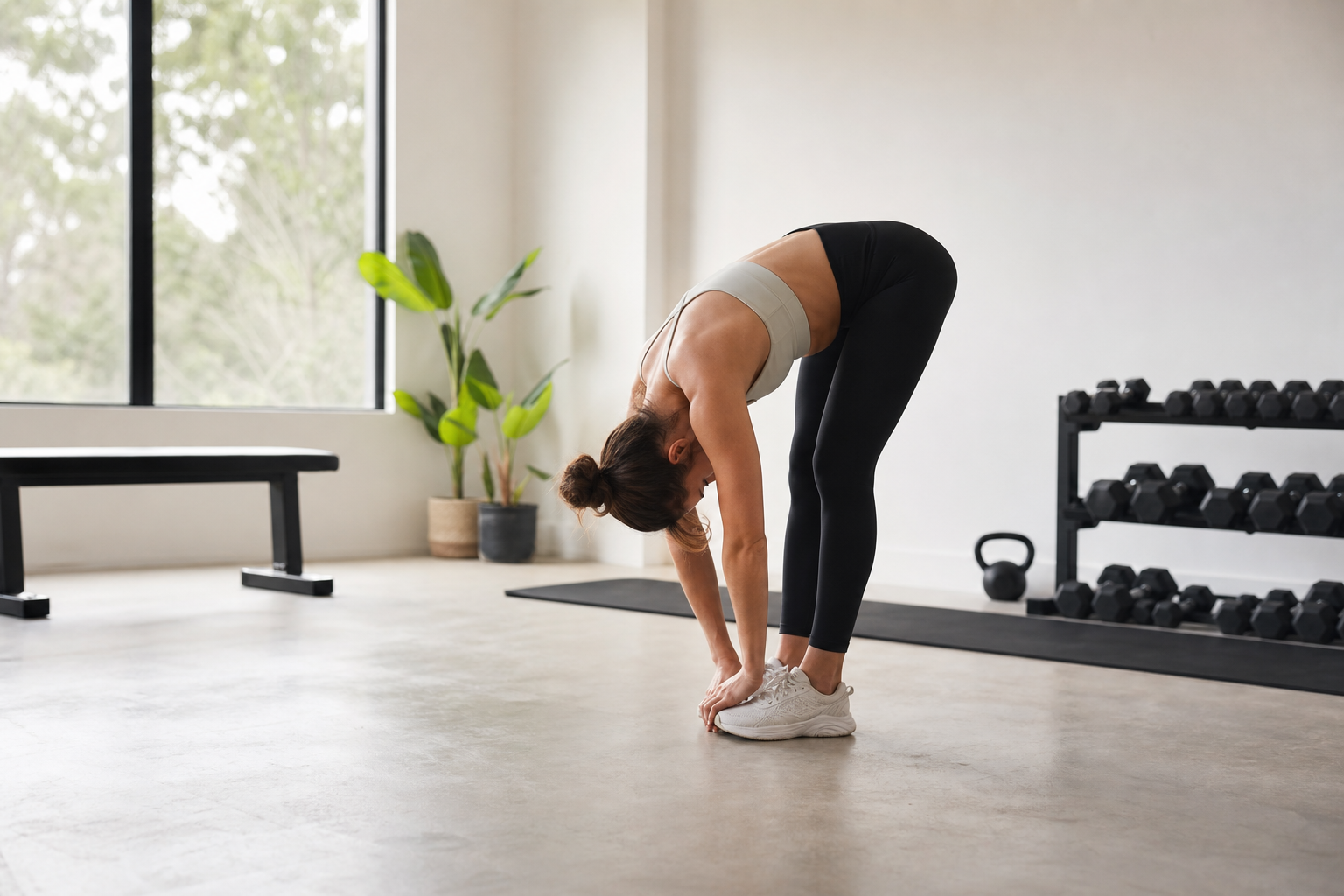
| Standing hamstring reach | Hamstrings, lower back | Static | 30-60 sec, 2 sides |
| Kneeling hip flexor stretch | Hip flexors, quads | Static | 30-60 sec, 2 sides |
| Doorway chest/shoulder stretch | Chest, front shoulder | Static | 30 sec, 2-3 reps |
| Wall calf stretch | Calves, ankle | Static | 30-45 sec, 2 sides |
| Open-book thoracic rotation | Mid-back, spine | Dynamic | 8-10 reps per side |
| 90/90 hip switch | Hip internal/external rotation | Dynamic/mobility | 5-8 reps per side |
This takes about 12-15 minutes total. If you only have 10 minutes, keep the hamstring, hip flexor, and 90/90 switch, since hips and hamstrings are where most beginners lose the most usable range.
What Should I Do Before Stretching to Avoid Injury?
Do 5 minutes of light cardio or joint circles before static stretching, not after waking up cold or immediately after sitting still. Stretching a cold muscle increases strain risk because collagen fibers in tendons and muscle sheaths are stiffer and less able to absorb load until tissue temperature rises, a point explained in detail in a widely cited review of stretching for exercise and rehabilitation.
A concrete 5-minute sequence: 1 minute marching in place, 1 minute arm circles, 1 minute hip circles standing on each leg, 1 minute bodyweight squats, 1 minute ankle circles and calf raises. This mild sequence raises heart rate slightly and increases blood flow to the joints you're about to stretch, without pre-fatiguing the muscles the way an intense workout would.
Save deep static holds for after this warm-up, or after your workout when muscle temperature is already elevated. Static stretching cold tissue, or stretching aggressively right before heavy lifting or sprinting, is where most stretching-related strains happen.
How Often Should I Stretch, and What's the Best Time of Day?
Stretch for flexibility at least 2 to 3 times a week, and do mobility drills daily since 5 to 10 minutes is enough to keep progressing. The best time of day depends on your goal: mornings favor short dynamic mobility work because joint fluid is thicker and muscles stiffer right after sleep, while evenings favor deeper static stretching since core body temperature and tissue pliability are naturally higher later in the day.
A practical same-day plan if you only have one session: do 3 to 5 minutes of dynamic mobility drills before your workout or first thing in the morning, then save static holds for after activity or in the evening while watching television. If you train in the morning and it's your only window, keep static holds shorter (20-30 seconds) and rely more on dynamic movement to avoid stretching genuinely cold, stiff tissue.
Consistency across the week matters more than the specific hour you choose. Three scheduled 15-minute sessions per week, plus daily 5-minute mobility snacks, outperform one long weekend stretching binge.
The Real Timeline: How Long Results From Stretching Actually Take
Early gains in the first 1 to 2 weeks come mostly from your nervous system tolerating more stretch sensation, not from your muscles actually getting longer. This is why beginners often feel noticeably looser within days, a fast win that can be misleading about how quickly deeper change happens.
Between roughly 4 and 8 weeks of consistent training, actual tissue adaptation begins: connective tissue and muscle fascicles start to remodel, and range-of-motion gains become more durable rather than disappearing after a few missed sessions. Reviews of stretching protocols, including a systematic review on stretching and range of motion, generally support several weeks of regular sessions before structural change is measurable, rather than days.
By 3 months and beyond, sustained practice can shift posture and default joint positions, the phase where sitting less hunched or standing with hips more neutral starts to feel automatic rather than effortful. If progress stalls around week 6 to 8, it usually means frequency dropped, not that your body stopped responding.
Can You Improve Flexibility and Mobility at Any Age?
Yes, connective tissue and joints remain adaptable throughout life, but older adults should extend warm-up time and progress more gradually rather than expect the same pace as someone in their twenties. A study of adults aged 55 to 86 found that those who stayed physically active maintained significantly greater flexibility across multiple joints than sedentary peers of the same age, evidence that training effect, not age alone, drives most of the difference, as shown in research on flexibility in older adults.
Practical adjustments for anyone over roughly 60: extend the warm-up to 8-10 minutes instead of 5, hold static stretches slightly shorter (20-30 seconds) but do more repetitions (3-4 instead of 2-3), and skip ballistic or bouncing stretches entirely since tendons lose some elasticity and recover from micro-strain more slowly with age.
Age changes the timeline and the intensity ceiling, not the ability to improve. Someone starting mobility work at 65 can still gain meaningful, functional range within the same 4-8 week window as a younger beginner, just with more conservative progression.
Do Foods or Supplements Help With Flexibility?
No food or supplement directly makes a muscle more flexible, but hydration and adequate protein support the connective tissue that stretching actually targets. Dehydrated muscle tissue is stiffer and less pliable, so drinking enough water is a supporting factor, not a fix on its own.
The most specific evidence involves collagen production, not flexibility directly. In a controlled trial, participants who consumed 15 grams of gelatin with 50 milligrams of vitamin C about an hour before short bouts of exercise showed roughly double the blood markers of collagen synthesis compared to those who didn't, according to research on vitamin C and collagen synthesis. That study measured tendon and connective tissue building blocks, not joint range of motion, so it's evidence for tissue resilience, not proof that gelatin or vitamin C will make you touch your toes faster.
Treat nutrition as a background supporter of the tissue you're training, not a shortcut around consistent stretching. Nobody has shown a food or supplement that replaces the 4-8 week adaptation window described above.
Are There Risks? Can You Stretch Too Much?
Yes, overstretching, especially into an already loose or unstable joint, can do more harm than good rather than being automatically safer. People with joint hypermobility, meaning their joints move beyond the typical range and feel loose or 'double-jointed,' are particularly at risk when they chase deeper stretches, since pushing further into a joint that already lacks structural stability can worsen instability and pain rather than fix tightness, a distinction discussed in clinical work on hypermobility and joint laxity.
The practical rule for anyone: a stretch should feel like mild pulling tension, never sharp, burning, or joint-centered pain. If a position causes shaking, numbness, or pain that lingers after you release it, that's a signal to back off the range, not push further.
If you suspect you're hypermobile (loose joints, frequent minor sprains, joints that 'pop' into odd positions easily), prioritize controlled strengthening through your existing range over adding more passive stretching, and consider a movement screen from a physical therapist before starting an aggressive flexibility routine.
Frequently asked questions
Is it bad to stretch every day?
No, daily mobility drills of 5-10 minutes are generally safe and even recommended, since they're active and controlled. Daily maximal static stretching held for long durations is less necessary and offers no proven extra benefit over 2-3 dedicated flexibility sessions per week.
Should I stretch a muscle that's injured or sore?
Avoid deep static stretching directly on an acute injury or very sore muscle, since pulling on inflamed or damaged tissue can delay healing. Gentle, pain-free range-of-motion movement is usually fine, but check with a physical therapist if pain persists beyond mild soreness.
How do I know if I'm hypermobile?
Common signs include joints that bend beyond a typical range, frequent minor sprains, or being able to touch your thumb to your forearm easily. A clinician can confirm this with a simple screening tool called the Beighton score, which checks flexibility at several joints.
Can stretching before bed help with morning stiffness?
Evening stretching can help since muscles are warmer and more pliable later in the day, and some people find it reduces how stiff they feel on waking. It won't eliminate normal morning stiffness caused by reduced joint fluid movement overnight, which loosens naturally within the first 10-20 minutes of moving around.
Do I need equipment to improve mobility?
No, most mobility drills like hip circles, thoracic rotations, and controlled squats use only bodyweight. A resistance band or foam roller can add variety later, but they are not required to see the phase-1 and phase-2 gains described in the timeline above.
Sources
- Current Concepts in Muscle Stretching for Exercise and Rehabilitation (2012)
- Acute Effects of Muscle Stretching on Physical Performance, Range of Motion, and Injury Incidence (2016)
- Flexibility of Older Adults Aged 55-86 Years and the Influence of Physical Activity (2013)
- Vitamin C-Enriched Gelatin Supplementation and Collagen Synthesis (2017)
- Hypermobility and the Hypermobility Syndrome (2007)